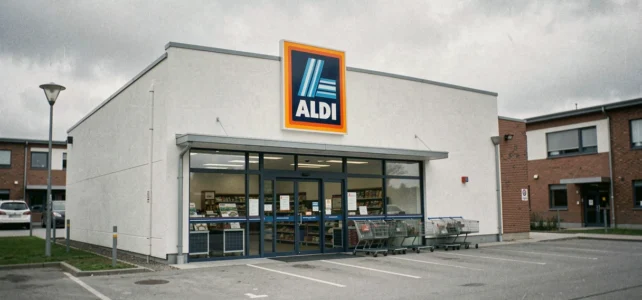
With over 12,000 stores spread across about twenty countries, Aldi represents one of the densest food distribution networks in the world. How did a family grocery store founded in 1913 in Essen, Germany, manage to build a model that today generates several tens of billions of euros in revenue? The data from its recent expansion, particularly in France, allows us to gauge the scale of the phenomenon.
Aldi’s Investments in France: The Development Plan Figures
Aldi France’s growth plan provides a direct insight into the group’s strategy. The brand aims to increase its number of stores from approximately 1,300 to 1,600 stores in ten years, which means nearly 300 additional openings. These locations target not only large urban areas but also medium-sized towns and rural areas.
The announced budget to finance openings, relocations, reconstructions, and expansions reaches approximately 500 million euros per year in France. This level of investment, presented to the French Senate in 2026, reflects a repositioning that goes beyond merely maintaining market share.
| Indicator | Current Situation | 10-Year Goal |
|---|---|---|
| Number of stores in France | Approximately 1,300 | 1,600 |
| New stores planned | – | Nearly 300 |
| Annual investment in France | – | ~500 million euros |
| Targeted cities (examples) | – | Lille, Salbris, Janzé, Hyères, Saint-Égrève |
To better understand Aldi’s history and its stores, we must trace back to the roots of the discount model invented by the Albrecht family, a model whose founding principles remain evident in this contemporary expansion strategy.
The Discount Model Invented by Karl and Theo Albrecht
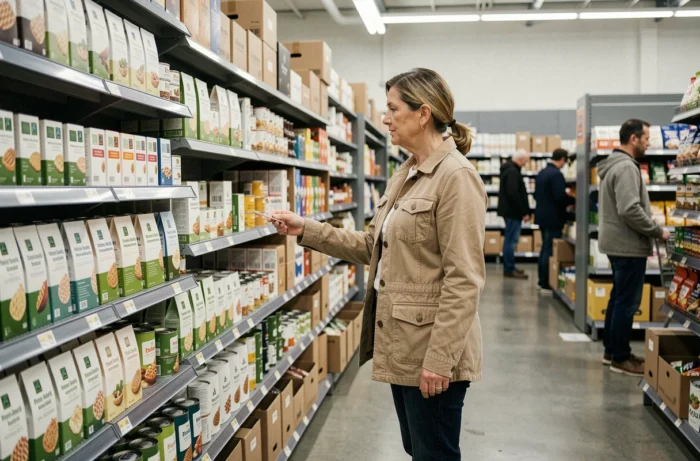
Anna Albrecht opened a grocery store in 1913 in Schonnebeck, a modest neighborhood in Essen, Germany. Her sons Karl and Theo took over the business after World War II. As early as 1947, they established a principle that would become their hallmark: discount applied to food.
Their method is based on a deliberately reduced assortment, compressed operational costs, and low margins compensated by volume. Self-service stores, adopted very early by the Albrecht brothers, allow for a drastic reduction in shelf staff.
The Split of 1961: Aldi Nord and Aldi Sud
In 1961, a disagreement over the sale of cigarettes in stores led to the division of the company into two legally independent entities. Karl took the lead of Aldi Sud (Southern Germany), while Theo headed Aldi Nord (Northern Germany). This dividing line, sometimes referred to as the “Aldi equator,” runs through the country and separates two groups that, despite a common name, pursue distinct strategies.
Aldi Nord operates in France. In contrast, Aldi Sud dominates in the United States, Australia, and the United Kingdom. This geographical distribution explains why Aldi stores do not present exactly the same logo or layout depending on the country.
New Aldi Store Format: What Changes Are Actually Happening
The recently opened or rebuilt stores in France follow state-of-the-art standards. The contrast with historical stores, often perceived as austere, is striking.
- Wider aisles and a redesigned customer journey to facilitate movement, especially with carts
- Less energy-consuming lighting, aligned with the group’s carbon footprint reduction goals
- More frequent delivery of fruits and vegetables, aimed at improving perceived freshness on the shelves
- Expanded sales areas, some reaching nearly 985 m² like the new generation store mentioned in the regional press
This qualitative shift responds to an evolution in the French market. Aldi no longer seeks to be associated solely with the lowest price, but aims for a positioning that combines discount and perceived quality. The brand is also increasing its range of recognized references (products labeled Taste of the Year, expanded organic ranges).
Aldi vs. Lidl in the French Distribution Market
The comparison between Aldi and Lidl in France reveals different trajectories despite similar origins. Lidl, also German, has gained a significant lead in the French market in terms of the number of stores and market share.
Aldi is explicitly seeking to close this gap. The plan for 300 openings directly targets areas where Lidl is already established. The targeted cities (Lille, Hyères, Janzé, Carentan-les-Marais, Mers-les-Bains) show a methodical territorial networking strategy, covering both coastal areas and rural basins.
The Aldi Nord group is investing heavily in modernization to no longer suffer in comparison in terms of customer experience. The old stores, often located on the outskirts in aging premises, are gradually being relocated or rebuilt. In contrast, new locations prioritize sites with higher commercial visibility.
Aldi’s CSR Strategy: Recent Environmental Commitments
The environmental axis is becoming an increasingly visible differentiation lever. Aldi Sud has initiated a protein strategy (reducing the share of animal proteins in the offering) documented by independent analyses. On the Aldi Nord side, the construction of eco-efficient stores is accompanied by goals for reducing energy consumption.
- New buildings designed with materials that have a lower environmental impact
- Goals for reducing food waste integrated into logistical processes
- Expansion of ranges of plant-based protein products
These CSR commitments accompany the group’s commercial repositioning. They aim to attract a clientele that, beyond price, expects guarantees regarding the origin and impact of the products they purchase.
The story of Aldi, from a family grocery store in Essen to a network of over 12,000 stores, remains inseparable from the discount model invented by the Albrecht brothers. The data that best summarizes the current phase is the 500 million euros invested each year in France: an amount that places Aldi among the most aggressive distributors in the European food market.