
The engine warning light comes on just after an oil change or battery replacement, the diagnostic tool displays the code 1525F3, and the cruise control shuts off. One immediately thinks of a sensor or throttle body that needs replacing. In most cases, the fault is not mechanical: it is a reaction of the ECU to an electrical disturbance or a procedural oversight.
Battery under-voltage and false fault 1525F3: the most common scenario on Renault
On recent Renaults (Captur, Mégane, Clio), the CAN network connects several ECUs that continuously exchange data. When the battery voltage drops or fluctuates, even briefly, these exchanges become inconsistent. The engine ECU then interprets this micro-cut as a real fault and triggers the 1525F3.
This scenario typically occurs in two situations: either the new battery was not charged before installation, or the ignition was left in the accessory position for a long time during an oil change (headlights, car radio, ventilation). In both cases, the low voltage is enough to trigger the code without a mechanical failure.
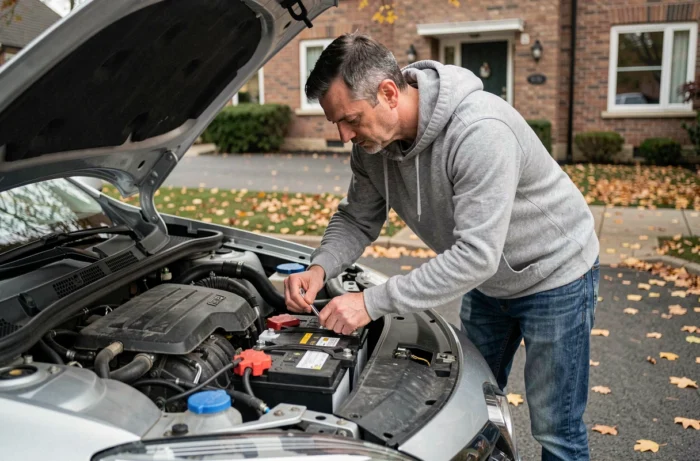
Before looking for a faulty sensor or ordering a throttle body, one should measure the battery voltage at rest and under load. If it is below the normal range, fully recharging it and then performing a driving cycle may be enough to clear the fault. Understanding the mechanisms behind the fault code 1525f3 on Renault can help avoid an unnecessarily expensive diagnosis.
Engine oil change and code 1525F3: what happens with pressure sensors
After an oil change, the 1525F3 does not arise from the oil itself, but from what happens around the operation. Two mechanisms come into play.
Inappropriate oil grade and pressure sensor signal
A different oil grade from the manufacturer’s recommendation alters the pressure in the circuit. The oil pressure sensor sends a signal that the ECU deems abnormal. On some Renault diesel engines, this inconsistency propagates to the CAN network and eventually triggers the 1525F3, even though the engine runs perfectly.
Using strictly the oil grade specified in the maintenance booklet eliminates this source of confusion. Feedback on this point varies according to the engines, but the risk mainly exists with oils that are too thin on blocks calibrated for a higher viscosity.
Prolonged ignition with the engine off
During an oil change, the ignition is often left on to check the dashboard or run accessories. On some vehicles, several minutes of ignition without the engine running are enough to draw on the battery to the point of generating micro-cuts on the CAN network. The ECU then records the 1525F3 without any mechanical component being involved.
The workaround is simple: limit the time of ignition with the engine off, or connect a battery maintainer during the intervention.
Throttle body relearning on Renault: the forgotten procedure
This is probably the most common mistake. After a battery disconnection (or a prolonged cut), the throttle body loses its calibration values. The ECU cannot find the resting position of the throttle and generates the 1525F3 upon restarting.
The relearning procedure is rarely mentioned in consumer manuals, and many garages overlook it after a simple battery change. It consists of:
- Turning on the ignition without starting the engine, then waiting about ten seconds for the ECUs to initialize.
- Starting the engine and letting it idle without touching the accelerator for a few minutes, allowing the throttle to recalibrate its position.
- Turning off the engine, waiting a few seconds, then restarting to validate the cycle. On some models, driving a few kilometers at moderate speed is necessary.
Without this relearning, the code 1525F3 systematically reappears, even after being cleared with the diagnostic tool. This is why some owners clear the fault three or four times before realizing that the problem comes from this missed step.
Residual or real fault 1525F3: how to tell the difference
Not all 1525F3 codes are ghosts. When the code persists after a complete driving cycle and a correctly performed relearning, a real problem must be considered. Here are the verification points that help make the distinction:
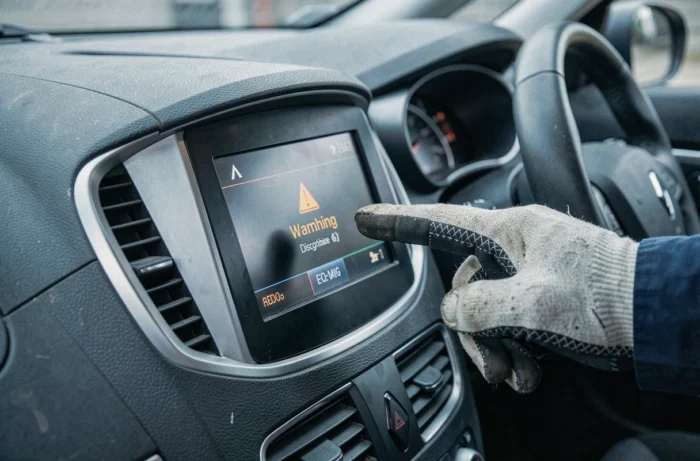
- Read the fault with the diagnostic tool after the driving cycle. A “present” (active) fault indicates an ongoing problem. A “stored” (past) fault often corresponds to a residue that has not yet been cleared.
- Check the connections of the throttle body and pressure sensor: a connector poorly reattached after an oil change or a bad contact on an oxidized battery terminal can be enough to maintain the fault.
- Monitor real-time values (fuel pressure, throttle position, network voltage) using a diagnostic tool. Stable values at idle with the code disappearing after driving confirm a residual fault, not a failure.
If the fault remains active with inconsistent values, the problem usually lies with the throttle position sensor, the engine wiring harness, or, more rarely, the ECU itself. At this stage, the intervention of a professional equipped with a manufacturer diagnostic tool becomes relevant.
Quick checklist before panicking over 1525F3
Here’s a summary of the steps to take in order, before ordering any parts or going to the workshop:
Measure the battery voltage at rest and under load. Check that the oil grade matches the recommendation. Perform the throttle body relearning procedure. Drive for about ten kilometers at moderate speed. Read the fault with the diagnostic tool to check if it is still active or simply stored.
In most cases, these steps are enough to eliminate the 1525F3 without mechanical intervention. The reflex to order a sensor or throttle body before checking the voltage and restarting the relearning remains the most costly mistake for this type of fault.