
The PIX exercise “penguin beach” relies on a precise mechanism: a beach image has been edited by overlaying penguins, and the task is to identify the hidden element in the original photo. The expected answer is a pineapple. But behind this seemingly trivial question lies a critical skill in visual literacy, that of reverse image search, which most candidates fail to spontaneously mobilize.
Reverse image search: the methodological lock of the PIX penguin beach exercise
The main blockage does not stem from a lack of technical skill. Feedback from teachers and trainers converges: most students faced with this exercise type “penguin beach pix” into a text search engine instead of submitting the image itself to a reverse search tool.
This confusion between text search and image search is the tipping point of the exercise. Google Images, Google Lens, or TinEye allow users to find previous occurrences of a photo by analyzing its visual characteristics, not its textual metadata.
We observe that understanding what the penguins hide on a beach requires going through this step of directly submitting the image to the engine; otherwise, the results returned only lead to correction pages, never to the source photo.
- Save the modified image to your device (right-click, “save image as”).
- Open Google Images and click on the camera icon to import the file.
- Analyze the results: the first occurrences often display the unedited version, where the pineapple appears in the exact location of the penguins.

PIX certification and Parcoursup integration: why this exercise matters
Since 2024, the results of the PIX certification are automatically integrated into Parcoursup for students at the end of cycle 4 and terminal cycle. An exercise like “penguin beach” is therefore no longer just an isolated training: it weighs in the digital profile transmitted to post-bac programs.
This automatic integration changes the game for teachers. The reverse image search exercise becomes a verifiable skill marker, not an optional bonus. A student who does not master the distinction between text search and visual search loses points in an entire skill area of the PIX framework.
Skill assessed in the framework
The exercise targets domain 1 of the CRCN (Reference Framework for Digital Skills): “Conducting a search and information monitoring.” The sub-skill mobilized is the ability to verify the source and integrity of digital content.
Finding the original image behind a montage amounts to applying a visual fact-checking approach. This is exactly what PIX seeks to measure, far beyond the simple answer “pineapple.”
Penguin photos and source verification: the pitfalls of image manipulation
The overlaying of penguins on a beach serves as a textbook case of collage editing. In real contexts, this type of manipulation is found in viral images on social media, where elements are added or removed to alter the meaning of a photo.
We recommend paying attention to several visual clues when suspecting an edit:
- The shadows cast by the added elements do not match the ambient lighting of the original scene.
- The edges of the superimposed objects often have a sharp outline or a resolution mismatch compared to the background.
- The photographic grain differs between the edited area and the rest of the image, especially when the two sources were taken with different sensors.
- The EXIF metadata of the file, when preserved, may reveal an editing software in the “Software” field.
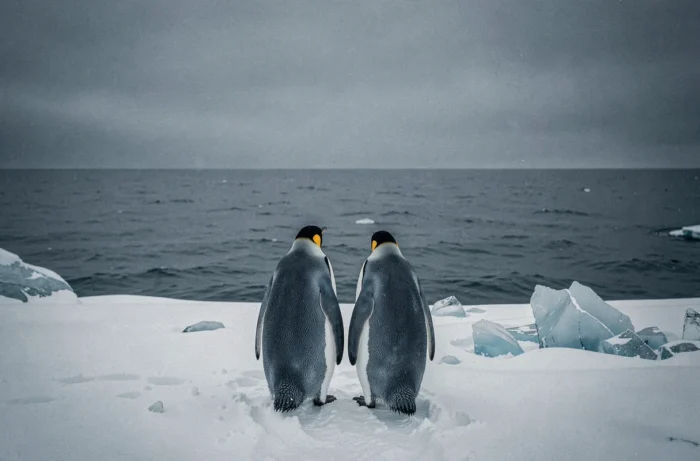
An amateur montage is often recognizable by inconsistencies in lighting and resolution even before resorting to a reverse search tool. In the PIX image, the penguins exhibit frontal lighting that contrasts with the low-angle light of the beach, which constitutes an exploitable visual clue.
Reverse image search tools: beyond Google Lens
Google Images remains the most used tool for reverse searches, but it is not the only one. TinEye indexes images differently and can find cropped or resized versions that Google does not detect. Yandex Images, for its part, excels in facial recognition and landscape photos.
For an exercise like “penguin beach,” Google Images or Google Lens are more than sufficient. However, in a professional context of source verification, cross-referencing multiple visual search engines increases the likelihood of tracing back to the original publication of a photo.
Technical limitations to be aware of
Reverse searches fail in certain specific cases. If the image has been heavily cropped, compressed, or subjected to a filter that alters colors, visual matching algorithms struggle to establish a link to the source. Screenshots of screenshots, common on social media, degrade the quality enough to obscure the trail.
Submitting the image in its highest possible resolution remains the best practice to increase the chances of finding the original. In the PIX exercise, the provided image is generally of sufficient resolution for the search to succeed on the first attempt.
The “penguin beach” exercise functions as a test of methodological reflex. The difficulty is not in finding the answer once the correct approach is identified, but in thinking to use the image as a query rather than words. It is this cognitive shift that PIX evaluates, and it is what distinguishes a user capable of verifying visual information from a user who merely consumes it.