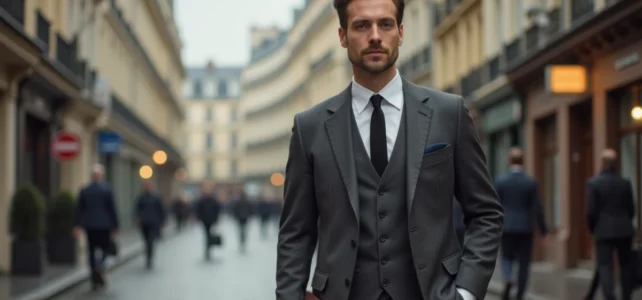
The high-waisted pleated trousers, the fitted short jacket, and the camp collar shirt are not museum pieces. They are cuts that structure a sharp masculine silhouette, provided they are taken out of their original context. The vintage style of the 60s for men works in 2026 when each piece is treated as a technical element, not as a costume.
Twill, flannel, and fine knit: the materials that lend credibility to a 60s look
The first mistake regarding mainstream items is to talk about cuts without ever addressing the fabrics. A sixties silhouette primarily depends on the material. Cheap polyester pleated trousers yield a flat and shiny result. The same trousers in cotton twill or wool flannel fall differently: the fabric has body, it holds the crease, and it ages well.
We recommend prioritizing five families of materials for a men’s wardrobe inspired by the 60s:
- Flannel (trousers, light jackets) for its natural drape and ability to absorb the false movements of cutting.
- Cotton twill (high-waisted chinos, short jackets) which offers a structured fit without rigidity.
- Fine knit (polo shirts, crew neck sweaters) that recalls mod silhouettes without overloading the upper body.
- Fine wale corduroy for autumn jackets and trousers, provided you don’t combine both in the same outfit.
- Light tweed in a jacket, worn open over a plain t-shirt, to break the formality of the fabric.
The logic is simple: a textured material does the work that three accessories cannot. The touch and drape of the garment are enough to convey a retro intention, without the need to multiply visual signals.
To delve deeper into the key pieces and their combinations, a visit to 60s men’s fashion on Buzzarium provides a solid foundation of references.
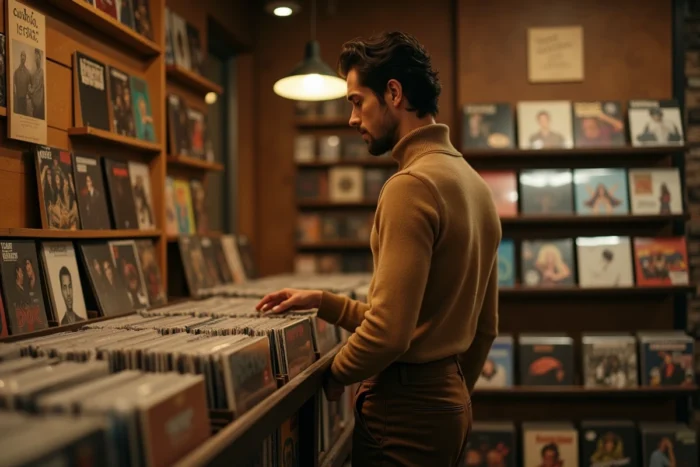
High-waisted trousers and short jackets: the masculine proportions of the sixties
The men’s wardrobe of the 60s is based on a precise play of proportions. The waist is marked high, often two to three centimeters above the navel. The pleated trousers structure the leg without clinging. The jacket stops at the hip, slightly fitted at the waist.
This high-short / low-long ratio is the visual signature of the decade. It elongates the silhouette and frees the bust. In 2026, the high-waisted pleated trousers return as a structuring piece, worn with contemporary tops: a simple white t-shirt, a fine knit polo, a plain sweatshirt.
The rule of one strong piece per outfit
The most relevant content converges on this point: one piece inspired by the 60s per outfit is sufficient. If the trousers are clearly sixties (pleated, high-waisted, straight or slightly flared leg), the top remains neutral and current. If the fitted short jacket carries the look, the bottom should be discreet with raw denim or a simple chino.
Combining a retro jacket, pleated trousers, a camp collar shirt, and penny loafers turns an outfit into a stage costume. One vintage marker per look prevents caricature.
Camp collar and mod-inspired shirts: wearing the top without overdoing it
The camp collar shirt (open collar, without collar button, often in fluid fabric) is noted among the most present cuts this year. It comes directly from the men’s wardrobe of the 60s, popularized by cinema and British mod culture.
Tucked into high-waisted trousers, it creates a clean silhouette. Worn open over a t-shirt, it acts as a light overshirt. We observe that the most successful version in 2026 features sober colors (ecru, navy blue, olive green) rather than tropical prints that steer the garment towards a holiday vibe.
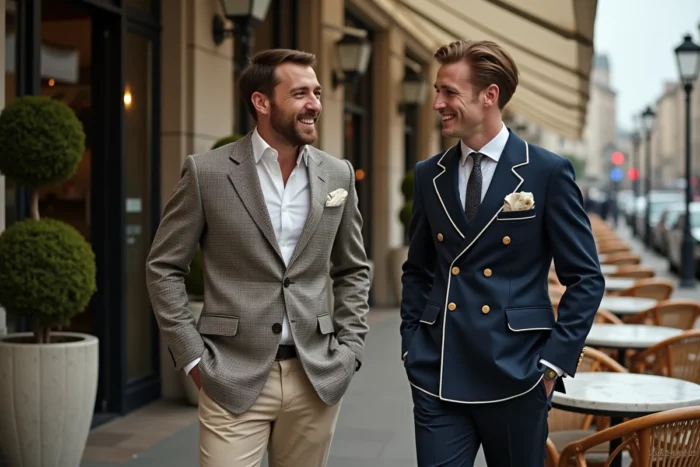
Fine knit and polo: the alternative to the camp collar
The fine knit short-sleeve polo, tucked into pleated trousers, remains an effective shortcut to the mod aesthetic. The knit should be dense enough not to deform after the first wash, but fine enough to fit the torso without highlighting every flaw.
The fine knit crew neck sweater works on the same principle. The fine knit replaces the tie as a finishing element: it structures the upper body and gives a polished look without any additional accessories.
Second-hand and anti-fast-fashion law: the context that makes vintage relevant in 2026
France has adopted legislation aimed at limiting advertising for fast fashion. This regulatory framework, even deemed timid by some observers, pushes the market towards second-hand and durable pieces. The 60s men’s wardrobe, based on classic cuts and robust materials, fits directly into this logic.
Buying flannel trousers or a tweed jacket from a thrift store is not a militant gesture. It is a pragmatic decision. Vintage pieces from the 60s are often better constructed than their new counterparts at comparable prices. Double stitching, reinforced buttonholes, heavier fabrics: the quality of craftsmanship from this era remains a tangible argument.
- In thrift stores, first check the condition of the inseams and armholes, the two areas of maximum tension on a 60s garment.
- Favor pieces made from natural fibers (wool, cotton, linen) whose aging is predictable and often aesthetic.
- Have the length of the legs or the width of the shoulders altered rather than searching for the perfect cut in second-hand, as the standardized morphologies of the time do not correspond to current sizes.
Mixing a vintage piece with current brands that work on sixties-inspired cuts allows for building a coherent wardrobe without solely relying on thrift store finds. The 60s men’s style works better as a grammar of cuts than as a historical recreation.
The high-waisted trousers, the short jacket, the fine knit, and the camp collar form a vocabulary of four pieces. Four pieces are enough to hold an entire wardrobe, provided they are treated as tools for silhouette rather than nostalgic quotes.