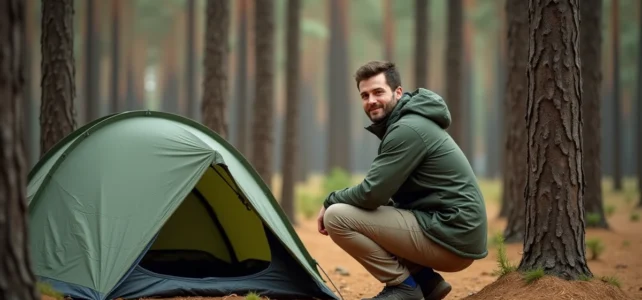
Pitching your tent among the pines, a few kilometers from the ocean, with no neighboring plots or barriers: this is the promise of bivouacking in the Landes. The department remains one of the most wooded in France, with a long coastline and inland lakes that offer rare opportunities to sleep outdoors. However, you need to know where to set up camp without risking a fine or endangering the forest.
Fire risk in the Landes forest: the primary criterion
Before choosing a spot, it’s essential to understand a constraint specific to the Landes. The maritime pine forest that covers most of the territory is extremely fire-sensitive. During dry periods, fires are often prohibited, even for a simple camping stove. A spark is enough to ignite a fire in these resinous pine woods.
This risk is not a logistical detail. It conditions the choice of location, season, and equipment. In the height of summer, bivouacking in the middle of a dense pine plantation is more about recklessness than adventure. The edges of lakes or dune areas offer a greater safety margin.
Have you noticed those ubiquitous “fire risk” signs along the Landes roads? They are not decorative. Check the risk level published daily by the prefecture before you go. When the risk is very high, certain forested areas are completely off-limits, even on foot.
To identify areas where bivouacking and wild camping in the Landes remain feasible, favor sectors away from the densest forests and check the current municipal orders.
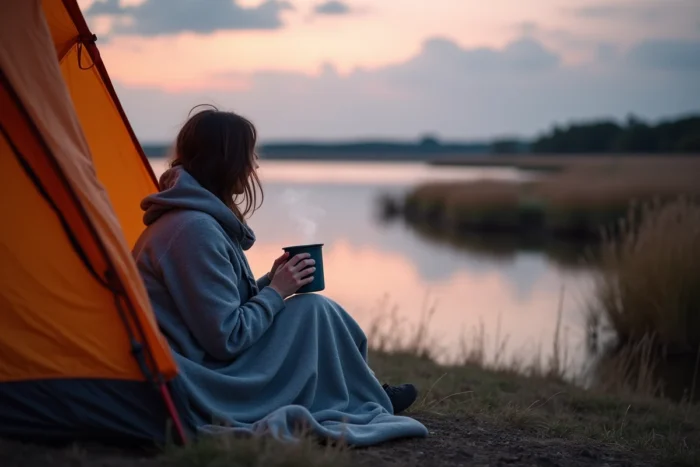
Bivouacking near Landes lakes: Biscarrosse, Sanguinet, Parentis
The lakes are the most suitable spots for bivouacking in the Landes. Less exposed to the wind than the coastline, surrounded by forest but with clear shores, they combine tranquility and relative safety.
Lake Biscarrosse and Parentis
Lake Biscarrosse is particularly attractive for its size and the diversity of its shores. Some areas remain less frequented off-season, with discreet access on the east side. The principle remains the same everywhere: setup after sunset, departure before sunrise. This is the definition of bivouacking, as opposed to wild camping, which implies a prolonged stay.
Parentis-en-Born, on the same body of water, offers wooded areas set back from the shore. The advantage: fewer people, more vegetation cover. The downside: often sandy and uneven ground, requiring an appropriate mattress.
Lake Sanguinet
Further north, Lake Sanguinet has accessible banks from several forest paths. The southern area of the lake, less urbanized, allows for finding flat spots just a few meters from the water. Be careful, in July and August, attendance increases significantly, as do inspections.
Coastal spots between dunes and forest: what really works
Sleeping facing the ocean is a dream, but the reality of the Landes coastline imposes limits. Regulatory pressure on the coastline has increased in recent years, reducing the possibilities for free bivouacking by the sea. The Coastal Law strictly regulates the occupation of the immediate surroundings of beaches.
The beaches themselves are generally prohibited for bivouacking by municipal order. What works, however, is to set up further back, in the transition zone between dunes and forest. A few areas still lend themselves to this practice:
- The back dunes between Contis and Mimizan offer sheltered flats from the wind, often accessible via bike paths or forest trails. The sandy ground packs well under a lightweight tent.
- The Seignosse area, on the forest side, has natural clearings set back from the road. The proximity to the beaches remains an asset, provided no trace is left behind.
- Further south, between Vieux-Boucau and Messanges, coastal paths cross less developed areas where a one-night bivouac goes under the radar, as long as setup and dismantling times are respected.
In any case, stay away from protected dune areas, identifiable by wooden fences (those fences that hold back the sand). Setting up there damages a fragile ecosystem and exposes you to a fine.
Structured bivouac spots in the Landes: a rising alternative
In recent years, platforms have been offering bookable bivouac spots on private land or in managed natural micro-sites. This model is actively developing in the Landes and represents a credible option for those who want to sleep in nature without the uncertainty of wild spots.
The principle: a private plot or a natural space made available for one night, with a minimum of amenities (water point, sometimes dry toilets). The price is generally modest, well below that of a traditional campsite.
Why does this option deserve your attention? Because it simultaneously solves three problems:
- The legality: you are on land where the owner has given their consent, eliminating any risk of a fine.
- The fire risk: structured spots often have cleared areas and access to water, reducing danger.
- The tranquility: no need to take down the tent at dawn or fear a patrol passing by at midnight.
Ensure that the chosen spot has clear fire department access, especially during the summer months. This is a reliable indicator of the manager’s seriousness.
Equipment and reflexes for bivouacking in the Landes without leaving a trace
The ground in the Landes is almost everywhere sandy or very loose. A standard tent peg holds poorly. Plan for long stakes, sand-type, or weigh down the guy lines with bags filled with sand. A freestanding tent simplifies life.
As for reflexes, never make a fire, even with a gas stove, during high-risk periods. Opt for cold meals if the alert level is high. Take your waste with you, including dishwater. Sand absorbs fats poorly and attracts insects.
Last practical point: Landes mosquitoes are formidable from June to September, especially around the lakes. An integrated mosquito net in the tent is not a luxury; it’s a necessity. Without it, the night can quickly turn into a nightmare.