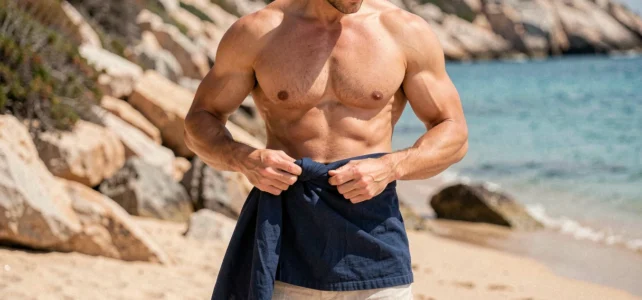
The men’s pareo is a rectangle of fabric, most often made of cotton or viscose, that drapes around the waist or hips to form a wrap skirt. Its principle is based on a play of tension and knotting that keeps the fabric in place without any mechanical closure. Mastering this simple gesture changes everything: a well-tied pareo stays in place while walking, does not ride up in the wind, and goes beyond the strictly beachwear category.
Tension of the fabric and double knot: the foundation of a secure pareo
The primary cause of a slipping pareo is fabric that is too loosely placed around the waist. Before even thinking about the style of the knot, it is essential to understand the friction mechanism that prevents the drape from coming undone.
Place the middle of the pareo against your stomach, slightly below the navel. Bring the two ends to the back, cross them behind you, then bring them back to the front. At this stage, pull firmly so that the fabric hugs the waist without any floating folds. The fabric-skin contact creates the necessary friction.
Then tie a double flat knot at the hip or slightly off-center towards the front. The double knot prevents the gradual slipping caused by a simple knot, especially with fine cotton. Tuck the loose ends under the fabric belt to prevent them from flapping in the wind.
Knowing how to tie a men’s pareo correctly requires controlling this initial tension: fabric that is too tight wrinkles and rides up, while fabric that is too loose falls off with the first step.
Tying a men’s pareo at the waist: the fitted wrap
The wrap knot is the most common. It produces a sleek silhouette, similar to loose bermuda shorts, and is suitable for both the beach and a lunch on the terrace.
Classic wrap method
- Hold the pareo horizontally in front of you, arms spread, with the upper edge at waist level.
- Wrap the right end around the right hip towards the back, then bring it to the front on the left side, crossing over the left end that remains pressed against the stomach.
- Make a double flat knot at the left hip, ensuring that the fabric remains taut at the waist.
- Adjust the length: the lower edge should fall between the middle of the thigh and the knee for a balanced drape.
A pareo that is too short gives a bathing skirt effect, while a pareo that is too long weighs down the silhouette. A reliable marker is just above the knee.
Low variant on the hips
For a more relaxed look, lower the knot point below the navel, at the level of the iliac bones. The fabric then falls lower and creates a slightly looser drape. This variant works well with a long pareo but requires an even tighter knot to compensate for the reduced friction on the hips.
Men’s pareo worn off the beach: layering and urban silhouette
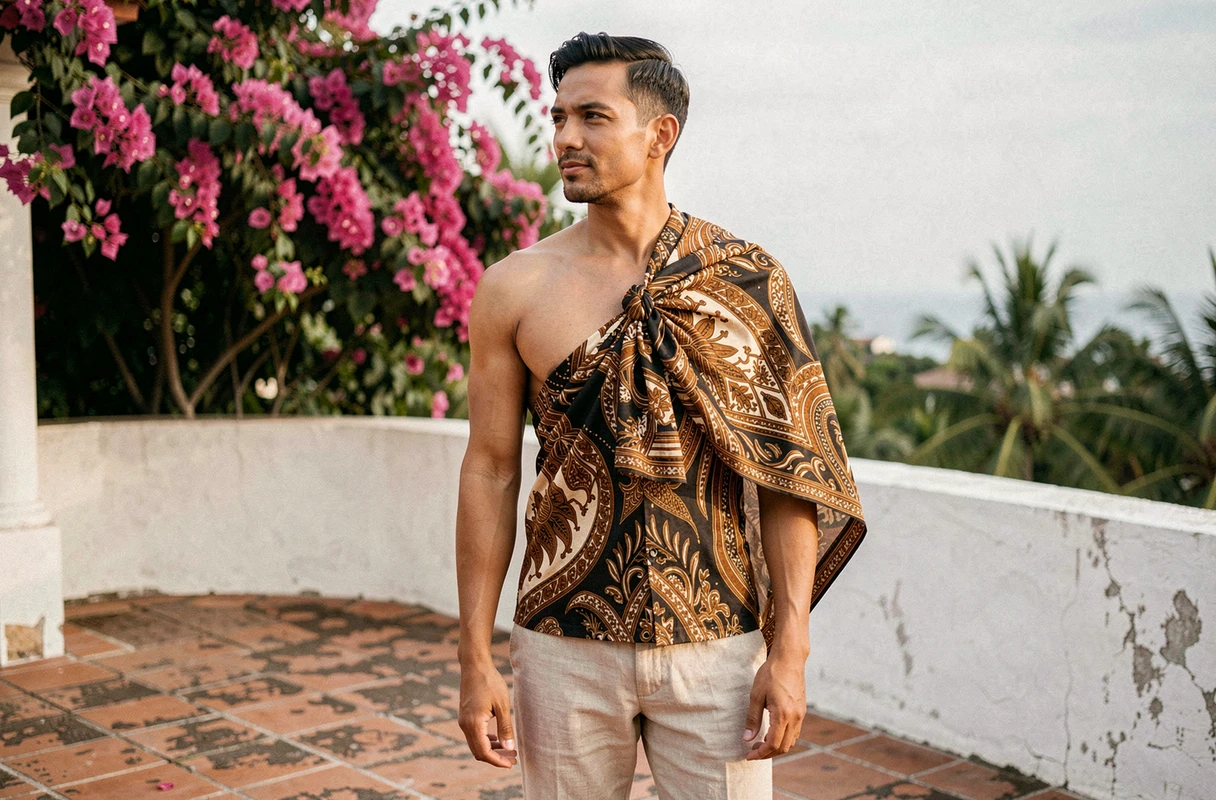
The pareo is no longer reserved for the sand. Recent fashion silhouettes show it worn as an asymmetrical layer over summer pants, in a style that borrows from the Asian sarong.
The idea is simple: tie the pareo over linen pants or lightweight chinos, letting it fall to one side like a draped apron. The knot is made at the waist, over the pants’ belt, ensuring a solid hold. The pareo then becomes a layering accessory, not a substitute for bottoms.
To ensure the result does not look like a costume, three points matter:
- Choose a pareo in a matte fabric (thick cotton, linen) rather than a shiny viscose that immediately evokes the beach.
- Stick to solid colors or discreet patterns (fine stripes, tone-on-tone batik) rather than saturated tropical prints.
- Wear the pareo asymmetrically, open on one leg, with a tucked-in t-shirt to define the waist.
This style works for an after-beach, an evening on the terrace, or a holiday aperitif. The matte fabric and discreet knot make the difference between a beach look and a resort look.
Choosing the fabric and size for a stable knot
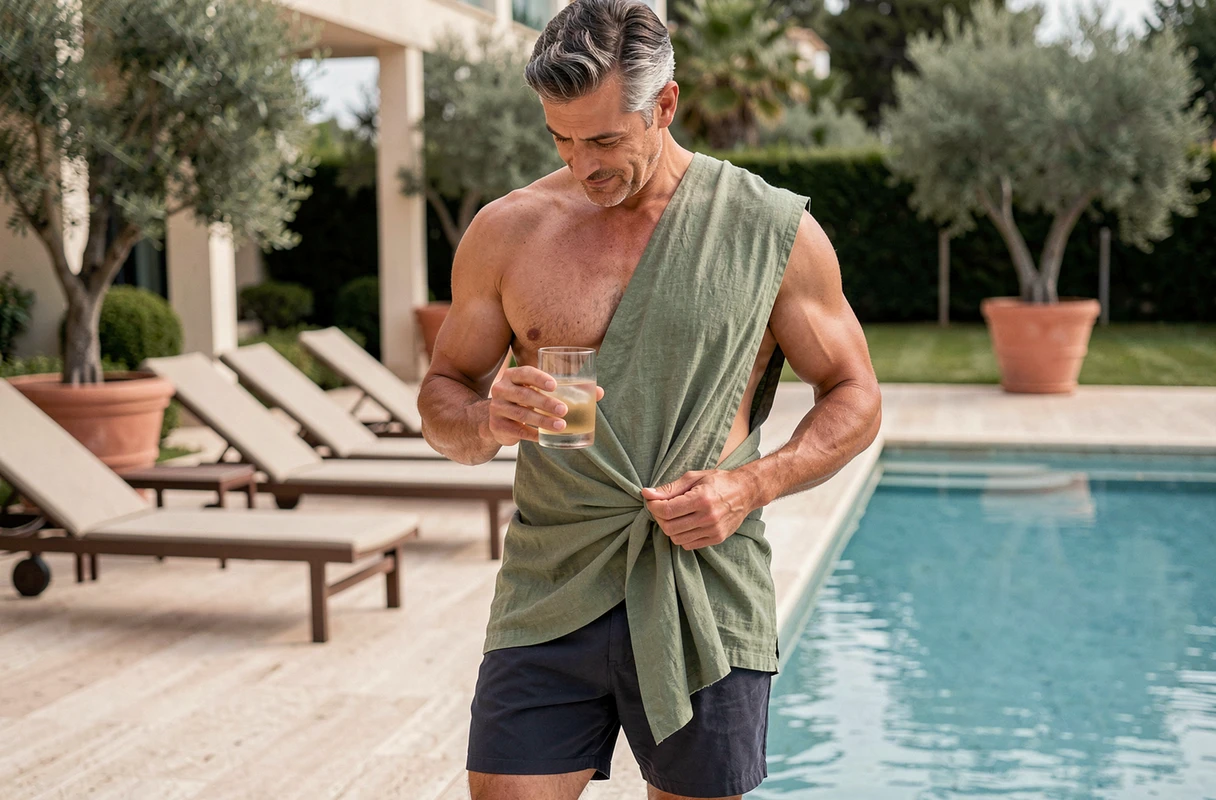
The behavior of the knot directly depends on the fabric. A dense-weight cotton offers more friction and slips less than fine viscose. For regular use, prefer a tightly woven cotton pareo over a synthetic voile.
The size of the rectangle also matters. A pareo that is too narrow requires maximum tension, which reduces the margin for creating a beautiful drape. A rectangle about twice the waist circumference provides enough fabric to cross the ends and form a comfortable knot without excess material.
Traditional Tahitian pareos are generally cut in generous dimensions, making them versatile. A pareo that is too small limits knotting options and forces a tight fit that is unflattering.
Common mistakes that break the elegance of the pareo
A visible and bulky knot placed at the center of the stomach is the most common trap. It draws attention to the wrong place and gives a towel effect. Shifting the knot to the hip is enough to change the entire silhouette reading.
Another mistake: letting the loose ends flap in the wind. Tucking the ends under the fabric belt or rolling them before tying produces a neater result. The wind no longer lifts the fabric because the grips are eliminated.
A wrinkled pareo also gives a careless appearance. A simple hand smoothing or a quick steam will restore a clean drape to the fabric, making all the difference between a well-kept drape and a hastily tied piece of fabric.
The men’s pareo gains elegance when the technical gesture is mastered: calibrated tension, off-center flat knot, suitable fabric. The rest is a matter of context and confidence in wearing it.