
A face is something you look at in a few seconds. You perceive harmony, imbalance, fatigue, freshness. Entrusting the aesthetics of your face to a practitioner means accepting that an outside perspective intervenes in this immediate perception. The choice of this expert is not solely based on their technical mastery. It also involves their ability to understand what you are seeking, and sometimes to protect you from requests that would be detrimental.
The role of a safeguard against aesthetic excesses
You may have noticed on social media those retouched faces that all end up looking alike? Puffed lips, prominent cheekbones, a frozen forehead. This phenomenon illustrates a real risk: the loss of aesthetic reference points due to filters and trends.
A competent facial expert does not simply execute a request. They assess whether this request is consistent with the patient’s morphology, age, and the overall balance of their features. Knowing how to say no to an inappropriate retouch is a legitimate medical act.
The pressure from altered images can trigger a form of addiction to corrections. Every small imperfection becomes unbearable, and every result calls for an additional adjustment. The experienced practitioner identifies these spirals and sets a framework. They explain why an additional injection would unbalance the face, why an overly corrected feature would lose its natural character.
An article dedicated to facial aesthetics on Santé Radieuse details this approach centered on preserving the patient’s identity rather than transforming it.
This safeguard function distinguishes a reliable practitioner from a mere technician. Trust arises from the physician’s ability to refuse an act, not just from their ability to perform it.
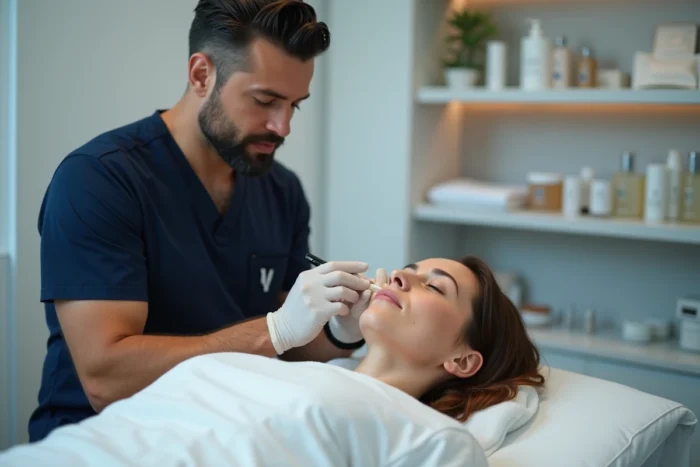
Concrete criteria for evaluating a facial aesthetic medicine expert
Reputation or the number of followers on social media is not enough to judge a practitioner. Several verifiable elements can establish real trust.
- The prior written estimate: in France, the practitioner must provide a detailed estimate before any aesthetic act for medical purposes. This document mentions the devices used (brand, lot number, CE marking). Its absence is an immediate warning signal.
- Experience with your skin type and specific morphology matters more than a general academic title. A practitioner accustomed to darker skin will approach injections differently than a specialist in lighter skin.
- Organized post-procedure follow-up: a serious expert plans a follow-up consultation and remains reachable in case of complications. This follow-up is an integral part of the protocol, not an optional service.
- The treatment philosophy, visible from the first consultation: the practitioner who takes the time for an in-depth dialogue before proposing anything demonstrates a patient-centered approach.
A doctor who rushes through ten-minute consultations without a detailed examination of the face at rest and in motion is working on an assembly line. The quality of the initial consultation predicts the quality of the result.
Philosophy of naturalness and lasting results for the face
The best results in facial aesthetics are those that no one notices. The patient appears rested, rejuvenated, harmonious, without being able to point to a specific act. This pursuit of naturalness requires a fine understanding of facial anatomy.
Aging is not just about wrinkles. It involves a loss of volume, a loosening of tissues, a change in skin texture. An effective treatment targets several of these mechanisms simultaneously, rather than focusing on a single perceived flaw.
Injections and facial treatments: balance rather than filling
Hyaluronic acid injections illustrate this logic well. Used judiciously, they restore lost volume and smooth certain areas without freezing the expression. When overdone, they create a “mask” effect that ages the face instead of rejuvenating it.
The expert adjusts the quantity, depth, and injection area for each face. They work in small touches, see the patient again after a few weeks, and make adjustments if necessary. This gradual approach protects against excessive results.

Transparency and traceability: obligations that protect the patient
Beyond the practitioner’s competence, the French regulatory framework offers concrete guarantees. The obligations of transparency and traceability have been strengthened for aesthetic acts with medical purposes.
The practitioner must be able to provide the exact identity of each injected product: brand, lot, CE certification. This traceability allows for quick intervention in case of an adverse reaction, even months after the act.
A practitioner who refuses to provide this information does not deserve your trust. This criterion is simple, binary, and allows for no exceptions.
Questions to ask during the first consultation
The first meeting with an aesthetic doctor is not a sales pitch. It is a space for mutual evaluation. The patient assesses the practitioner as much as vice versa.
- What products do you use and why those rather than others?
- What realistic result can I expect with my morphology?
- In what cases do you refuse to perform a procedure requested by the patient?
The third question is the most revealing. A practitioner who has never refused a procedure probably lacks the ethical benchmarks necessary to support you in the long term.
Facial aesthetic treatments are part of a duration. Results evolve, skin changes, and needs transform with age. The right expert is the one who builds a trusting relationship capable of lasting for years, not the one who promises a spectacular result in a single session.