
Finding the right help at the right time remains the main obstacle for elderly people and their loved ones. Between administrative procedures, unknown financial aids, and scattered local services, accessing reliable information requires time and energy. Specialized platforms today centralize these resources to quickly direct each senior to the solution suited to their situation.
Number 3133 and reporting abuse: a relay still too unknown
Have you ever searched for an emergency number to report a concerning situation regarding an elderly loved one? Since March 1, 2026, the national number 3133 has replaced the former 3977 to combat abuse against vulnerable adults.
This number is free, available 7 days a week from 9 AM to 8 PM, and accessible to deaf and hard-of-hearing individuals. The problem is that many families are unaware of its existence or still confuse it with the old systems.
This is where information structures dedicated to seniors come into play. They serve as local relays: they disseminate the correct number, explain the reporting procedure, and assist families in their initial steps. In practice, Info Seniors services consolidate this type of guidance on a single platform, which avoids navigating between multiple administrative sites.
An isolated senior or an overwhelmed caregiver does not always think to search on a government portal. A single entry point reduces the time between noticing a problem and taking the first concrete action.

Transparency in nursing homes: three indicators to check before choosing a facility
Law No. 2024-317 of April 8, 2024, known as the “Aging Well” law, introduced a transparency obligation for nursing homes. A decree from August 8, 2026, mandates the publication of three indicators on the official portal for-les-personnes-agees.gouv.fr:
- The staffing ratio of residents to medical, paramedical, and socio-educational staff, which provides a direct idea of staff availability on a daily basis
- The absenteeism rate of staff, indicative of working conditions and team stability
- The staff turnover rate, which signals high turnover and potentially degraded follow-up quality
These data existed previously, but they were buried in internal reports. Their mandatory publication changes the game for families.
In practical terms, how can these indicators be utilized? A low staffing ratio combined with a high turnover rate serves as a warning signal. Conversely, a facility that shows stable figures across these three criteria offers a minimal guarantee of continuity in support.
Comparing these three indicators among several nursing homes takes less than ten minutes on the official portal. Senior information platforms facilitate this comparison by explaining what each indicator means and how to interpret it without specific training.
Daily home assistance: going beyond cleaning and shopping
Home assistance for elderly people is often reduced, in the collective mindset, to cleaning and shopping.
The real issue lies elsewhere. Making medical appointments, managing budgets, or handling administrative tasks takes up considerable time, especially when autonomy declines.
Identifying financial aids suited to each situation
Why do so many seniors miss out on aids they are entitled to? Because the landscape of assistance is fragmented. Between the APA, CCAS aids, Agirc-Arrco provisions, and local aids, each personal situation opens different rights.
A concrete example: Agirc-Arrco offers travel assistance for retirees over 75, with no income conditions. This scheme funds daily trips (medical appointments, social outings). Few retirees apply for it, due to a lack of awareness of its existence.
Senior information platforms act as a filter. They ask the right questions (age, income, family situation, level of autonomy) and then direct individuals to the relevant provisions. A personalized diagnosis avoids filling out applications for unsuitable aids.
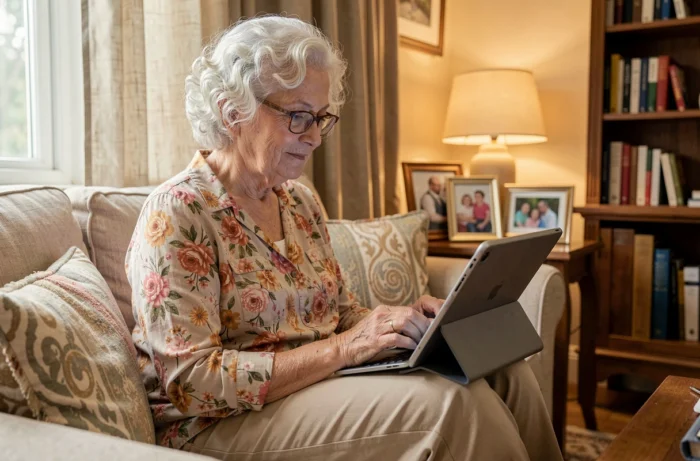
Social connection and prevention of isolation: beyond teleassistance
Teleassistance is often the first reflex when thinking about the safety of seniors at home. This system remains useful, but it only addresses part of the problem: physical emergencies.
Social isolation, on the other hand, progresses silently. A senior who no longer goes out, who no longer receives visits, who has no regular interlocutor sees their mental and physical health deteriorate long before an alarm button becomes necessary.
Regular home visit services exist, supported by associative actors or local authorities. These visits do not replace family connections, but they create a recurring human contact point.
A weekly call or visit allows for detecting a deterioration before it becomes an emergency. The role of information platforms is to catalog these services locally, as their availability varies greatly from one municipality to another.
CCAS and local information points: the territorial network
The Communal Centers for Social Action remain the primary local contact. They direct individuals to municipal aids, senior clubs, and prevention measures. Local information points dedicated to elderly people complement this network by offering free support to both caregivers and seniors.
The challenge lies in the visibility of these structures. Many municipalities have an Info Seniors point without the residents knowing it. Specialized online directories allow for locating these contact points in just a few clicks, by postal code or by type of need.
Staying at home relies on a combination of coordinated solutions: housekeeping, medical follow-up, social connection, housing adaptation. None of these components work in isolation. Quick access to structured and up-to-date information remains a prerequisite for every elderly person to benefit from the provisions that suit them.