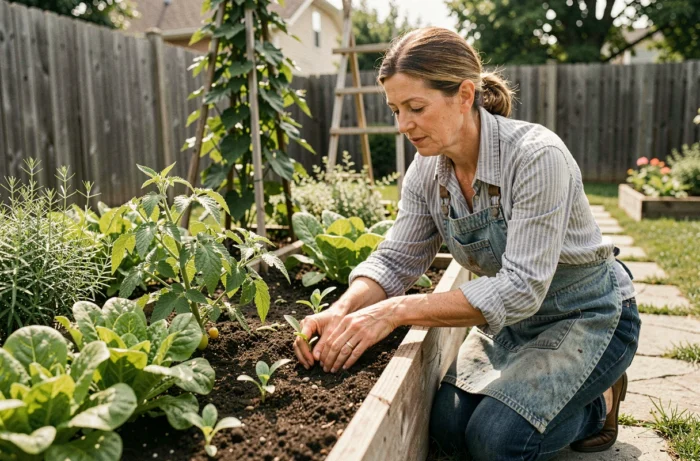
Your zucchinis are growing, your tomatoes are ripening, then everything stops in a few weeks. A productive vegetable garden and a pleasant garden all year round depend on precise choices, not on the number of hours spent outside. Adapting watering to new regulatory constraints, working the soil rather than forcing it, choosing varieties that alternate throughout the seasons: this is what separates a lasting vegetable garden from one that falters.
Watering Restrictions in the Vegetable Garden: What Drought Orders Change in Practice
Since the summer of 2026, several French departments have prohibited watering gardens and lawns during large time slots. The prefectural orders explicitly distinguish between ornamental gardens and productive vegetable gardens. Departments like Loiret or Deux-Sèvres require that you only water the vegetable garden before 8 AM or after 8 PM.
Failure to comply with these restrictions can result in a 5th class fine. The fine can reach 1,500 euros, and 3,000 euros in case of repeat offenses. This is no longer a theoretical risk: the press reminds us of these amounts every summer.
For gardeners, this means rethinking the organization of watering. A drip hose programmed early in the morning avoids forgetfulness and respects the authorized time slot. Mulching becomes a non-negotiable reflex: it reduces evaporation and allows you to manage with less water. The resources available on graine-de-jardinier.com detail these techniques adapted to current cultivation constraints.
Have you noticed that bare soil dries out in a few hours after watering, while mulched soil remains moist for several days? This mechanism makes the difference between a resilient vegetable garden and one that depends on the hose.
Mulching and Soil Covering: The Action That Replaces Several Treatments
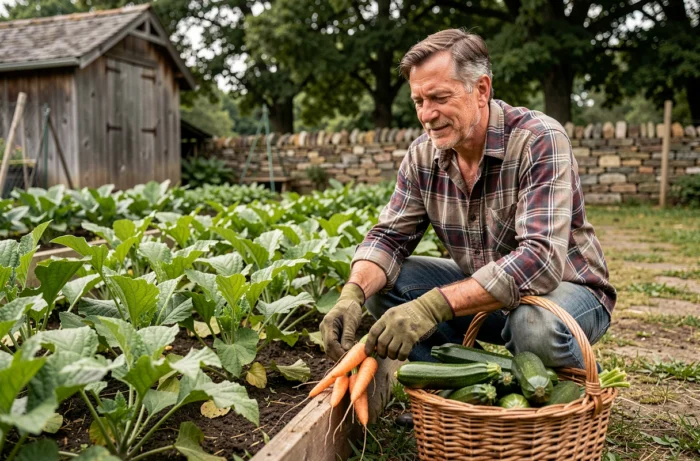
Mulching is not only used to retain moisture. A layer of organic matter (dead leaves, dried grass clippings, straw, wood chips) nourishes the soil fauna as it decomposes. Earthworms and mycorrhizal fungi do the fertilization work for you.
A permanently covered soil compacts less, retains water better, and promotes deep rooting of vegetables. In contrast, bare soil left between two crops loses its structure and requires the addition of fertilizers to compensate.
What Materials to Use According to the Season
- In summer, straw and dried grass clippings protect the bases of tomatoes and zucchinis from direct heat. They also limit the growth of weeds at the base of the plants.
- In autumn, shredded dead leaves spread over the cleared plots decompose all winter and enrich the soil for the following spring.
- Between two crops, a green manure (phacelia, mustard, clover) covers the living soil and fixes atmospheric nitrogen in the ground, ready for the next crop.
Mulching also partially replaces chemical weeding. Since the ban on pesticides for individuals, covering the soil remains the simplest method to limit unwanted weeds without repeated effort.
Crop Rotation and Associations in the Vegetable Garden: Avoiding Soil Depletion
Planting tomatoes in the same spot every year eventually depletes the soil of certain nutrients and encourages the accumulation of specific diseases (downy mildew, nematodes). Rotation involves changing the location of each botanical family from one season to the next.
The principle is simple: fruiting vegetables (tomatoes, peppers, eggplants) do not return to the same plot for three or four years. Legumes (beans, peas, fava beans) naturally enrich the soil with nitrogen and prepare the ground for the nutrient-hungry crops that will follow.
Associations That Really Work
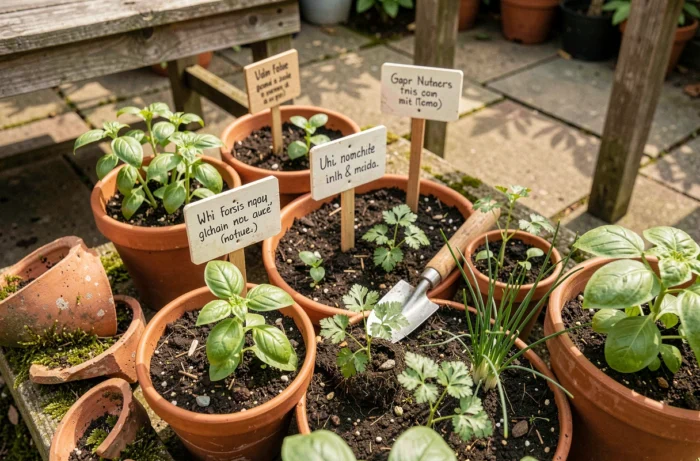
Some associations are well documented. Basil planted at the foot of tomatoes does not cure downy mildew, but it attracts pollinators beneficial for fruit set. Carrots and leeks, grown side by side, protect each other from their respective flies thanks to their crossed scents.
However, avoid grouping all vegetables from the same family on a single bed. Distributing solanaceous plants across several areas reduces the spread of diseases if one plant is affected.
Flowers and Shrubs to Beautify the Garden Without Increasing Maintenance
A pleasant garden all year round does not require replanting everything each season. Perennials (lavender, sage, echinacea, yarrow) come back on their own every spring. They require only one pruning per year and attract beneficial auxiliary insects to the vegetable garden.
Why choose this over annuals? Because a well-established perennial bed requires less watering, less weeding, and zero reseeding. The time saved directly benefits the vegetable garden.
Edible Hedges and Small Fruits
Planting a mixed hedge with small fruit shrubs (blackcurrant, redcurrant, raspberry) serves two functions at once. It visually structures the garden while producing harvests over several weeks. A well-exposed edible hedge produces fruit as early as the second year after planting.
- The blackcurrant and redcurrant tolerate partial shade and are pruned at the end of winter.
- The remontant raspberry provides fruit from early summer until the first frosts.
- The often-overlooked elderberry offers flowers for cooking and berries for jams, while serving as a refuge for insectivorous birds.
These shrubs require neither treatment nor intensive watering once established. They fit into a logic of an autonomous garden, where each plant has a useful role beyond mere decorative aspects.
The vegetable garden and the garden benefit from being thought of as a single space. Flowers attract pollinators to fruiting vegetables, hedges break the wind that dries out crops, and mulching circulates from one area to another. A garden that operates on a short maintenance circuit produces more with fewer interventions, season after season.