
The first months of a newborn’s life involve a multitude of physiological and relational changes that can unsettle even the most prepared parents. Sleep, feeding, medical follow-up, emotional state of adults: each dimension interacts with the others, and recommendations evolve regularly. This article provides an overview of the reliable guidelines to know for supporting a baby from birth until the end of the first semester.
Safe Sleep for Infants: What Current Recommendations Say
The issue of sleeping arrangements remains one of the most debated topics in perinatal care. French (HAS), American (AAP), and British (NHS) health authorities share a common foundation: place the baby on their back, on a firm and flat mattress, without pillows or blankets. However, opinions diverge on certain points, particularly regarding co-sleeping.
The HAS discourages strict co-sleeping (same sleeping surface), while the NHS adopts a risk-reduction approach by listing situations where bed-sharing is particularly dangerous (alcohol consumption, smoking, prematurity). The AAP maintains a firm recommendation against bed-sharing, while advocating for room-sharing (separate bed in the parents’ room) during the first six months.
Parents who wish to keep their baby close at night can opt for a co-sleeping crib attached to the adult bed, a solution compatible with most guidelines. The sleep environment is just as important as the position: a room temperature of around 18-20 °C and the absence of any soft objects in the crib remain constants in all recommendations.

To delve deeper into these equipment questions and find guidelines on suitable materials for newborns, specialized resources like pausebebe.com allow for comparing available options based on the age and needs of the infant.
Parental Mental Health: An Issue Recognized by the 1000 Days Policy
Since 2024, the public policy of the 1000 first days in France has included a specific section dedicated to parental mental health. The parenting pathway established organizes systematic identification of psychological vulnerabilities during existing follow-up appointments: early prenatal interviews, postnatal consultations, child examinations in PMI.
A national experiment included in the Social Security funding law has established a structured pathway for managing postpartum depression, coordinated at the regional level. This system aims to shorten the time between the onset of initial signs and referral to a mental health professional.
Postpartum depression is not limited to the first weeks. It can appear several months after birth, including in the second parent. The signs to look out for are not limited to sadness:
- Persistent irritability, feelings of detachment from the baby, or loss of interest in activities usually enjoyed
- Sleep disturbances unrelated to those of the infant (insomnia while the baby sleeps, or marked hypersomnia)
- Recurrent intrusive thoughts related to the baby’s safety, accompanied by anxiety disproportionate to the actual situation
The early postnatal interview, which has been mandatory in France since 2022, provides a privileged moment to address these topics. Field reports vary on the actual completion rate of this interview, but its existence offers a legitimate framework to discuss emotional states with a health professional.
Sensorial and Motor Development: Stimulate Without Overstimulating
A baby’s development in the first months follows a rhythm unique to each child. Major milestones (eye fixation, voluntary grasping, rolling over) serve as guidelines, not rigid norms. A newborn who does not reach a milestone by the theoretical date does not necessarily have a delay.
The most effective awakening activities during this period are also the simplest. Skin-to-skin contact, carrying, eye exchanges, and words addressed directly to the baby simultaneously stimulate sensory abilities, attachment bonds, and the infant’s emotional regulation.
Some principles guide appropriate stimulation:
- Offer only one type of stimulation at a time (visual or auditory, rarely both together) for an infant under three months, whose nervous system still poorly filters simultaneous information
- Observe signs of fatigue or overstimulation (averted gaze, agitation, crying) and respect the pauses the baby imposes
- Favor objects with high visual contrast (black and white) during the first weeks, a period when visual acuity remains limited
- Allow the baby to explore freely on a firm mat, first on their back and then gradually on their stomach (under supervision), to promote gross motor development
Medical Follow-Up for Infants: Appointments That Structure the First Months
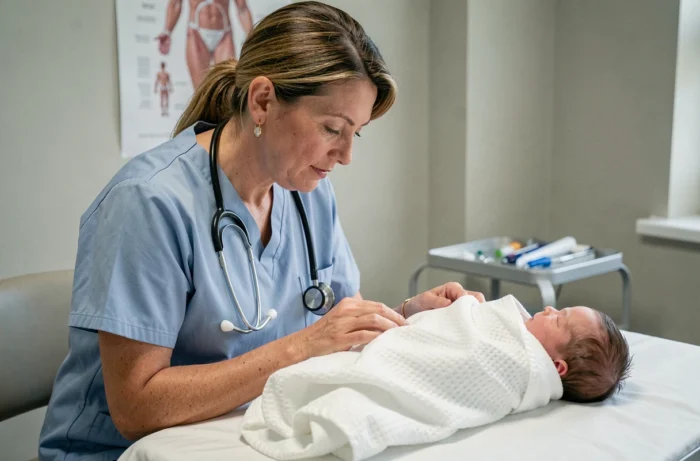
The medical follow-up calendar for an infant in France includes regular examinations during the first year. Each consultation allows for checking growth, neurological development, and general health status. The health record remains the reference document for tracking this information.
An infant’s skin, thin and permeable, requires special attention. Toiletry products should be limited to the bare minimum: a mild, fragrance-free cleanser is sufficient for bathing. Dermatologists recommend not bathing a newborn daily, with two to three times a week generally being suitable in the first weeks.
Signs that warrant prompt medical advice (aside from obvious emergencies) include fever in an infant under three months, prolonged refusal to feed, a sudden change in behavior, or inconsolable crying that differs from the usual pattern. Knowing the normal rhythm of one’s own baby is the best tool for detecting an anomaly.
Follow-up is not limited to the pediatrician or general practitioner. Consultations in PMI (Maternal and Child Protection) offer free support, accessible without an appointment in many departments, and are particularly useful for questions related to breastfeeding, sleep, or psychomotor development. This network of professionals serves as a safety net for families navigating the first months with an infant.