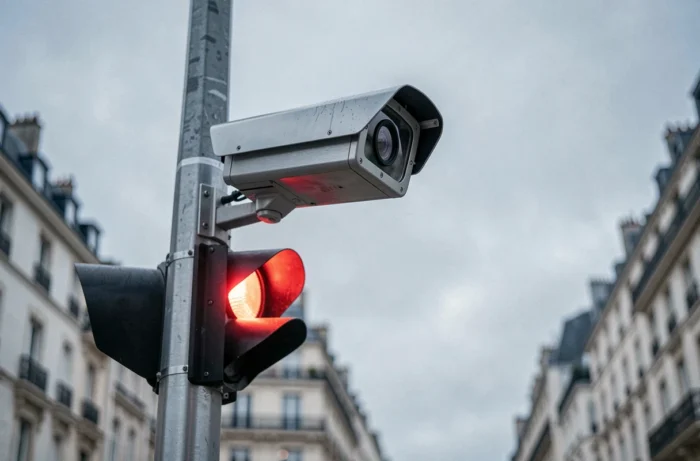
The cameras mounted on traffic lights do not form a homogeneous category. Behind an identical-looking casing coexist devices with radically different purposes: traffic management, video enforcement, automated control by radar. Confusing these devices means ignoring what triggers – or does not trigger – a sanction.
Magnetic loops and optical sensors: the ground detection layer
The least visible technical link of a red light radar is the magnetic loop embedded in the roadway. This inductive sensor detects the metallic mass of a vehicle crossing the light’s effect line. The system relies on two distinct loops, spaced a few meters apart.
The first loop triggers a snapshot when the vehicle crosses the stop line while the light is red. The second confirms the trajectory and allows for estimating the passing speed. This double control prevents false positives: a vehicle that stops between the two loops is not penalized.
There is a gradual transition to virtual loops through video analysis. The physical sensor in the pavement is replaced by a detection algorithm applied to the camera feed. The main advantage is maintenance: there is no longer a need to cut into the roadway to replace a faulty loop.
The downside remains sensitivity to lighting conditions and reflections on wet pavement. The operation of the red light surveillance cameras on Pulsion Laval details this detection logic in a Quebec context.
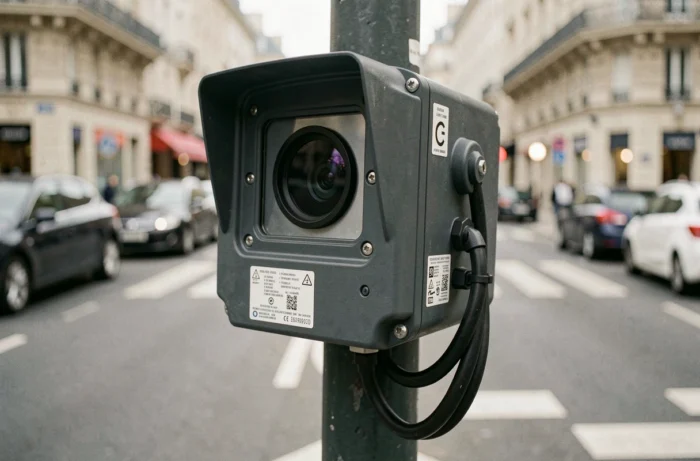
Multifunction radars at intersections: what next-generation devices change
The historical logic associates a casing with a single infraction. Red light crossing radars only monitored red light violations, sometimes coupled with speed measurement. This compartmentalized architecture is disappearing.
Several European countries are testing radars capable of accumulating multiple infractions at the same crossing: speed, red light crossing, failure to maintain safe distances, dangerous lane changes. These systems are in the experimental phase, with a planned rollout until 2030 on the most accident-prone urban and suburban routes.
For drivers, the consequence is direct: a single crossing can generate multiple distinct infractions.
Criteria for deploying these multifunction radars
- Intersections with a high rate of lateral collisions, where red light crossing results in T-bone impacts
- Suburban roads with high approach speeds, where the combination of speed and red light exacerbates the severity of accidents
- Intersections equipped with dedicated public transport, to protect bus and tramway priorities
Traffic management cameras and video enforcement: distinguishing what does not issue fines
The majority of cameras visible on traffic lights are not radars. Traffic management sensors serve a counting and regulation function. They measure vehicle density to adjust the duration of green-red phases in real time.
These sensors come in several forms: small black cameras aimed at the roadway, passive infrared detectors, or bus and tram priority modules. None of these devices generate fines. Their video feed feeds into a central traffic regulation station, not an automated system for processing infractions.
Video enforcement occupies an intermediate zone. An urban surveillance camera, sometimes installed near a light, transmits its images to a supervision center. A sworn officer can then observe an infraction live and issue a ticket. The difference with automatic radar is twofold:
- The infraction is observed by a human agent, not by an algorithm
- The range of infractions covered is broader (parking, phone use, seatbelt non-wearing)
- The device is not indicated by a radar sign, unlike approved fixed radars

T-bone collisions and rear-end collisions: the documented trade-off of red light cameras
The security argument in favor of red light cameras is based on reducing serious lateral collisions (known as T-bone collisions).
The downside is less publicized. The installation of red light cameras leads to a measurable increase in rear-end collisions. Drivers, aware of the device, brake more abruptly as they approach the light, surprising the following vehicle. In the most cautious analyses, the net benefit across all types of accidents is close to zero.
This trade-off explains why some North American cities have removed their red light cameras after evaluation. In Europe, the dominant logic remains the maintenance of devices, but road authorities are gradually integrating this parameter into the choice of equipped intersections. Intersections with a high proportion of two-wheelers or very dense lanes are less prioritized, as the risk of rear-end collisions is amplified there.
CNIL regulation and data protection
The images captured by red light radars are subject to a strict framework. The snapshots only retain the license plate and the immediate context of the infraction. The data retention period is regulated by the CNIL, which has strengthened its controls through simplified sanction procedures.
Traffic management cameras, on the other hand, generally do not store individualized images. Their feed is processed in real time to produce aggregated counting data, without vehicle identification.
Any confusion between these legal regimes exposes communities to sanctions. A traffic sensor repurposed for video enforcement without prior declaration constitutes a breach of the internal security code. The technical boundary between surveillance and regulation is tightening, but the legal framework maintains a clear separation between uses.