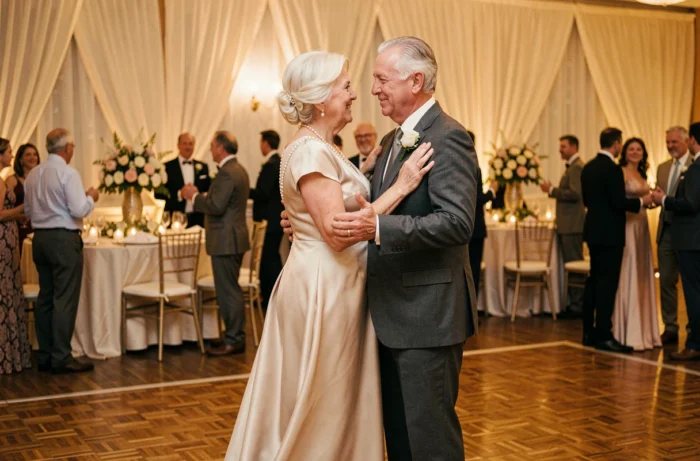
Fifty years of life together is half a century of shared memories, and the soundtrack for this celebration is not chosen lightly. Golden anniversaries often bring together three generations under one roof, with very different musical tastes. The playlist must take this reality into account so that every guest feels involved in the celebration.
Acoustic versions and intimate arrangements: the trend changing golden anniversaries
Competitors list songs by decade or theme, but overlook a deeper movement. Several recent guides on wedding playlists describe a shift towards acoustic versions, strings, and more organic atmospheres. Heavily produced tracks give way to stripped-down covers that put the lyrics front and center.
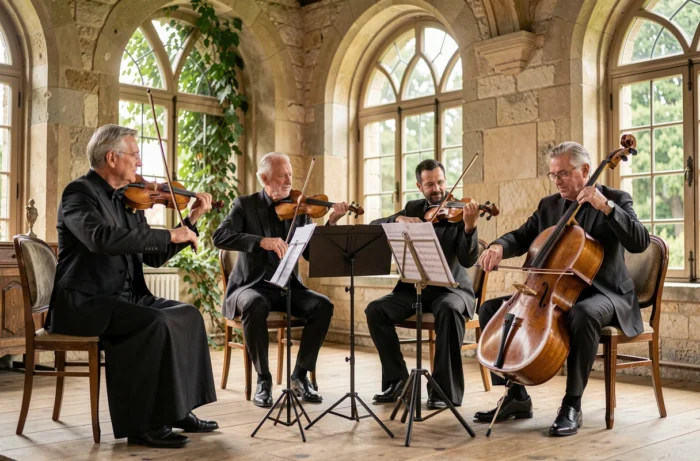
For a celebration of 50 years of marriage, this format works particularly well. A disco track rearranged for a string trio retains its recognizable melody while adapting to a seated meal. A 1970s standard played in a piano-vocal version can resonate with grandchildren who are unfamiliar with the original.
Choosing the right music for 50 years of marriage requires thinking about both the format and the repertoire. An acoustic cover of “Can’t Help Falling in Love” by Elvis Presley or “La Vie en rose” by Édith Piaf creates a bridge between generations without forcing anyone out of their comfort zone.
Multigenerational golden anniversary playlist: building a set across decades
The classic trap is to segment the music by age group: one block for grandparents, one for parents, one for the young. The result resembles three distinct parties strung together.
Event professionals emphasize a different approach: sets built around shared memories rather than age groups. A cross-generational track is one that several generations recognize for different reasons. “You’re the One That I Want” from Grease, for example, resonates with baby boomers who discovered it in theaters and thirty-somethings who heard it at retro parties.
Cross-generational tracks to consider
- “What a Wonderful World” by Louis Armstrong, released in the 1960s, covered in advertisements and films for five decades, recognizable by nearly all guests
- “La Bohème” by Charles Aznavour, a piece that evokes nostalgia and the passage of time, fitting for a long-term anniversary
- “Happy” by Pharrell Williams to get the dance floor moving with a unifying track that even the older guests have heard on the radio or television
The idea is not to please everyone at every moment, but to create moments where three generations share the same musical emotion.
Personalizing the wedding anniversary playlist: telling a story through music
Personalizing playlists has become a strong marker in event planning. A DJ recently interviewed noted that couples are increasingly seeking songs that tell their story, with mixes of generations, mashups, and adapted covers.
For golden anniversaries, this can take a concrete form. The couple likely has a song associated with their meeting, another with their wedding, and a third with a significant trip. Incorporating these key tracks into the playlist transforms the background music into a narrative.
How to structure this musical narrative
A chronological thread works well for the meal. Start with tracks from the 1970s (the era of the wedding), transition to the 1980s-1990s (raising children, working life), and then move to contemporary titles. The transition happens naturally, without announcement.
For the dancing portion, mixing eras works better. A sequence between a 1960s rock song and a 2000s hit maintains energy and prevents guests from leaving the dance floor while waiting for “their” decade.
Sound constraints at the venue: a often overlooked parameter
In France, amplified music is regulated more precisely than before in many reception venues. Sound limits exist for the public, and neighborhood protection obligations may require stopping or relocating music at certain hours.
This parameter directly influences song selection. A track that relies on powerful bass loses all its impact if the volume is restricted. In contrast, an acoustic or vocally dominant piece remains clear even at moderate volume.
- Check the end times for amplified music with the venue before finalizing the playlist
- Plan a calm sequence (jazz, bossa nova, soft French songs) for the end of the evening if sound constraints require a volume reduction
- Test the sound of the planned tracks at a reduced volume, as some songs lose their dynamics when restricted
These constraints are not a hindrance. They guide the selection towards tracks that work in all conditions, which is also a guarantee of musical quality.
The musical success of a golden anniversary celebration depends less on the number of tracks in the playlist than on the coherence between the pieces, the venue, and the guests present. A set of thirty well-chosen tracks, articulated around the couple’s story and adapted to the acoustic conditions, will leave a stronger impression than a list of a hundred songs without a guiding thread.