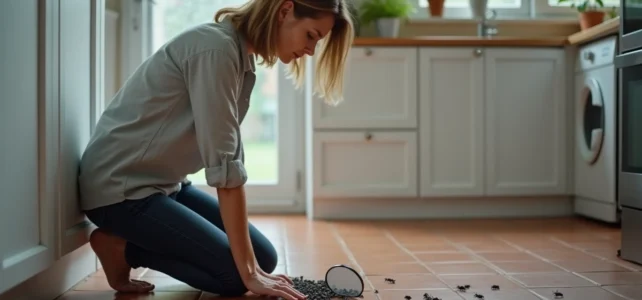
After a summer storm, dozens of tiny black insects appear on window sills, screens, and even skin. This phenomenon surprises every year, but these visitors are not all the same. Correctly identifying what comes into your home after the rain radically changes how to act.
Identifying the black insect based on the room where it appears
Not all small black insects after a storm are thrips. The room in which you spot them provides a reliable first clue.
In the kitchen or bathroom, the most common visitors are fungus gnats and springtails, attracted by residual moisture and decaying organic matter. Fungus gnats resemble small dark flies that hover around plant pots. Springtails, on the other hand, jump when disturbed.
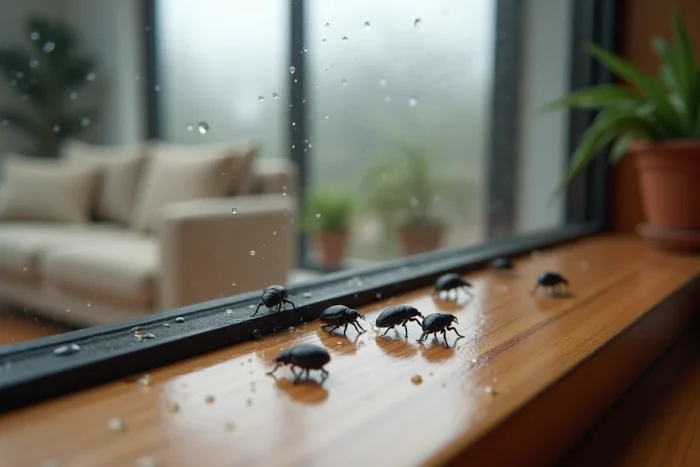
Near windows, on screens and television screens, they are almost always thrips. These insects measure between one and two millimeters, with elongated bodies and fringed wings. They arrive in swarms carried by the warm wind that precedes the storm.
On baseboards or in dark corners, a slow, round black insect could be a small beetle (such as an anthrenus or dermestid) or, in more concerning cases, an oriental cockroach. If the insect quickly flees from the light and measures more than one centimeter, the possibility of a black cockroach deserves serious checking.
Understanding this distinction prevents treating a thrips problem with methods intended for gnats, or vice versa. Have you ever noticed that some “universal treatments” never work? This is often because the targeted insect is not the one you think. A detailed article on storm pests and black insects in the house explains the morphological differences to observe closely.
Thrips after the storm: why they invade the house in waves
Thrips live in cereal fields and meadows during the growing season. When harvests begin or the air becomes heavy before a storm, they leave their habitat in large numbers. The wind sometimes carries them several kilometers away.
The storm does not create thrips; it moves them. The drop in atmospheric pressure and the rise in humidity prompt them to take flight en masse. They land on everything they encounter: skin, light clothing, bright surfaces.
Once inside, they do not reproduce in your home. They find neither food nor favorable conditions there. Their presence is temporary, linked to the weather episode. After a few hours without warm wind, the invasion stops on its own.
What specifically attracts them indoors
Thrips are attracted to light colors and light sources. A lit screen, a white wall illuminated by the setting sun, or light laundry spread near an open window act like magnets.
Closing windows on the prevailing wind side during the hours leading up to the storm significantly reduces entry. Standard screens do not always stop them, as their very thin bodies pass through regular mesh.
Effective mechanical actions against black insects after the rain
Before any product, mechanical actions resolve the majority of situations. They are quick, pose no risk to occupants, and target the actual insect.
- Vacuum the infested surfaces (window sills, frames, baseboards) and then immediately throw away the bag or empty the bin outside. This is the most effective action against a swarm of resting thrips.
- Isolate suspicious houseplants in a separate room and inspect the undersides of leaves. Thrips lay eggs in the foliage, and treating the potting soil and leaves is more useful than cleaning the countertop.
- Seal visible entry points: worn window seals, door bottoms without sweeps, ventilation grilles without fine filters. Post-storm humidity also attracts springtails and fungus gnats through these same openings.
- Install yellow or blue sticky traps near windows and plants. Thrips are attracted to these colors and get stuck. This trap also serves as a diagnostic tool: by counting the captured insects, you confirm the species present.
Removing plant debris around the house (accumulated dead leaves against walls, open compost too close to openings) eliminates humid refuge areas where these insects gather after the rain.
Treating indoor plants infested with thrips
If thrips have reached your plants, surface cleaning is not enough. The larvae hide in the folds of leaves and in the top few centimeters of potting soil. A single treatment kills the visible adults but leaves the immature stages intact.
Repeating applications every four to five days for several weeks is the only approach that really works. Each treatment cycle catches a new generation just as it becomes vulnerable.
Natural solutions to prioritize
A mixture of water and black soap sprayed on the foliage (both top and bottom) suffocates adult thrips on contact. Diatomaceous earth sprinkled on dry potting soil acts mechanically against crawling larvae.
Why avoid chemical insecticides indoors? Because thrips quickly develop resistance, and powerful products also eliminate beneficial auxiliaries if your plants go back outside later.
Sustainable prevention after each stormy episode
Prevention is based on a simple principle: reduce indoor humidity and eliminate entry points. Actively ventilating after the storm (once the wind has died down) helps expel residual humidity that attracts springtails and fungus gnats.
Checking window seals every spring, keeping gutters clean to avoid water stagnation against walls, and maintaining houseplants in good health (no constantly soggy potting soil) are the three most cost-effective preventive actions.
Post-storm invasions repeat every summer. By knowing how to distinguish a thrips from a springtail and by first acting with mechanical actions before looking for a miracle product, you can resolve the problem in a few hours instead of enduring it for weeks.