
Turning left on a two-way road remains one of the most accident-prone maneuvers in daily driving. The difficulty lies not in the action itself, but in the overlapping rules of priority that vary according to the type of intersection, the signage present, and the behavior of other road users. This article compares the most common scenarios to identify where judgment errors are concentrated.
Green light and left turn: a permission that does not equate to priority
The most widespread confusion among drivers concerns the green light. Many believe that a green light grants the right to turn left without further verification. Official guides from several countries (Quebec, Alberta, Norway) remind us of the same rule: a green light is a conditional permission, not an absolute priority.
In practice, a driver turning left at a standard green light must yield to vehicles coming from the opposite direction and to pedestrians crossing at the crosswalk. A recent Norwegian guide states the principle as follows: “a green light means proceed if the way is clear, not proceed at all costs”.
In Quebec, regulations specify that it is prohibited to enter an intersection if there is not enough space to completely cross it, even with a green light. This rule aims to prevent vehicles from blocking the intersection while waiting for a gap to complete their left turn, a situation that paralyzes cross traffic during the phase change.
Understanding the rules of priority for turning left in this specific context avoids most conflicts at signalized intersections.
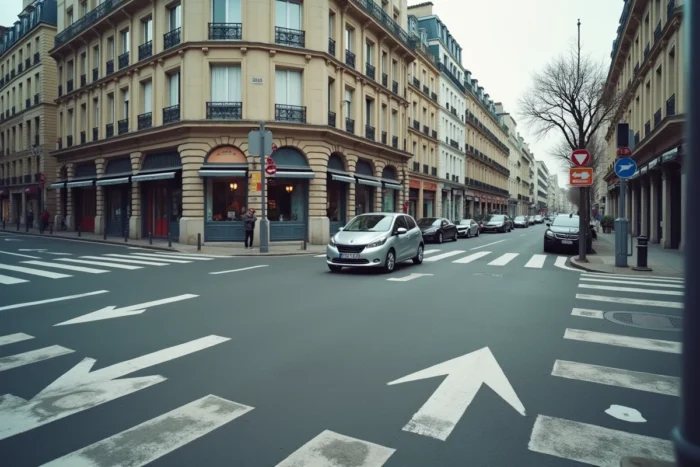
Comparison of priority situations for left turns according to the type of intersection
The obligations of the driver turning left change radically from one intersection to another. The table below summarizes the most common cases in French law.
| Type of intersection | Signage | Obligation of the driver turning left | Who has priority |
|---|---|---|---|
| Intersection without signage | None | Apply the priority to the right + yield to oncoming traffic | Vehicle coming from the right and vehicle in front going straight |
| Intersection with green light | Traffic light (solid green) | Yield to vehicles coming from the opposite direction and to pedestrians | Oncoming traffic, pedestrians at the crosswalk |
| Intersection with green directional arrow | Left arrow light | Clear lane to turn, check for pedestrians | The driver turning left (protected phase) |
| Intersection with yield sign | Inverted triangle | Yield to all road users on the priority road | All vehicles on the priority road |
| Roundabout | Yield sign at the entrance | Yield to vehicles already in the roundabout | Vehicles in the roundabout |
Reading this table highlights a central point: the only situation where turning left confers a true priority is with the green directional arrow. In all other cases, the driver turning left must yield to at least one category of road users.
Priority to the right and left turn: the trap of double constraint
The intersection without signage poses the greatest risk of error. The driver must simultaneously manage two distinct rules:
- The priority to the right, codified by article R415-5 of the highway code, which requires yielding to any vehicle coming from the right
- The obligation to yield to users traveling in the opposite direction when crossing their path to turn left
- The verification of pedestrians crossing the street into which one is entering, who retain priority over the turning vehicle
This overlap creates a situation where the driver turning left must monitor three flows simultaneously: right, front, and arriving pedestrian crossing. The classic error consists of focusing on the oncoming traffic while forgetting the vehicle coming from the right, or vice versa.
In contrast, on a priority road marked by a yellow diamond sign, the priority to the right no longer applies to vehicles on secondary roads. However, the driver turning left must still continue to yield to oncoming traffic on that same priority road.
The case of the Indonesian intersection
When two vehicles face each other and both turn left, they can pass each other in two ways. The “right-hand pass” (each vehicle passes in front of the other) is the most common method in France. The “left-hand pass” (each vehicle passes behind the other) is sometimes imposed by specific road markings.
In the absence of markings, the crossing is done to the right. The left turn signal must remain activated throughout the maneuver to clearly signal the intention to other road users.

Turn signal and positioning: obligations before turning left
The highway code imposes a precise sequence before turning left on a two-way road. Failing to follow this sequence constitutes an offense, but more importantly, it removes any clarity for other drivers.
- Activate the left turn signal early enough (the distance depends on speed, but the signal must be perceptible before braking)
- Move towards the center of the road, as close to the center line as possible, without crossing it
- Check the interior mirror and the left blind spot before any lateral movement
- Wait for a safe gap in oncoming traffic before cutting into the lane
On a three-lane road with a central left-turn lane, the driver must first join this central lane before stopping to wait for their gap. Stopping in the traffic lane to wait to turn is prohibited when a pre-selection lane exists.
The correct positioning of the vehicle before the turn reduces the conflict zone with oncoming traffic. A poorly positioned vehicle, remaining to the right of its lane while preparing to turn left, increases the distance and duration of the maneuver, thus increasing exposure to risk.
The green directional arrow remains the only device that truly secures the left turn by eliminating conflict with the opposing flow. Everywhere else, this maneuver relies on the driver’s judgment, their ability to assess the speed of oncoming vehicles, and strict adherence to the sequence of signaling, positioning, checking, and engaging.