
Gasoline vapors are composed of volatile organic compounds (VOCs), including benzene. When a gasoline smell appears in a home, it signals the presence of flammable and toxic molecules in the indoor air. Identifying the source takes precedence over any attempt at deodorization, as the risk is not only olfactory: it is chemical and, in some cases, explosive.
Benzene and VOCs: What a Gasoline Smell Reveals About Indoor Air Quality
Gasoline contains benzene, a carcinogenic VOC. Unlike the smell of cooking or mold, the smell of gasoline indicates the presence of molecules that, even in low concentrations, degrade indoor air quality far beyond mere discomfort.
According to the EPA, VOC levels inside a home can be up to ten times higher than those measured outside. Gasoline stored in an attached garage or exhaust fumes from a vehicle are among the explicitly cited domestic sources.
Understanding the meaning of a gasoline smell in the home helps distinguish a one-off source (spilled can) from a structural problem related to ventilation or storage.
The human nose detects gasoline at very low doses, which is an advantage: the olfactory alert precedes the immediate danger threshold by a wide margin. However, prolonged exposure to even moderate concentrations of benzene poses a long-term health risk, regardless of any fire hazard.
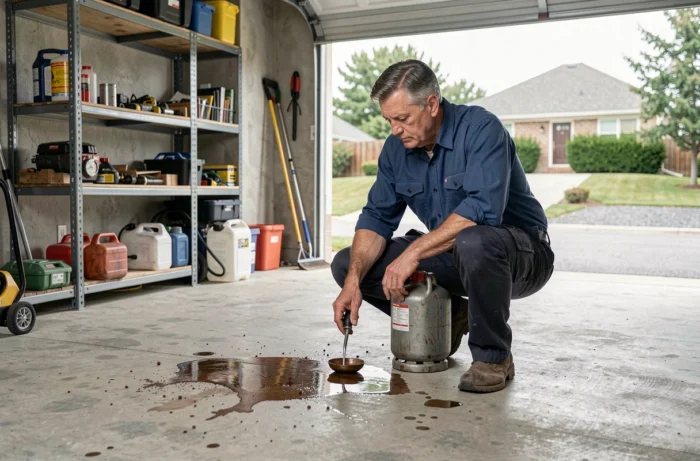
Technical Sources of Gasoline Smell in a Home
Most cases have a precise material explanation. Hydrocarbons are highly volatile: a tiny amount is enough to permeate the air of an entire room.
The Attached or Communicating Garage
This is the most common source. A recently parked vehicle, a gas-powered lawnmower, a poorly closed fuel can, or a defective tank cap release vapors that migrate to living spaces through doors, faulty seals, or technical ducts.
Gasoline vapors are heavier than air. They accumulate in lower areas, such as basements, crawl spaces, and stairwells. A poorly ventilated area below the garage concentrates vapors much more than a well-ventilated room at the same level.
Porous Floors and Residual Impregnation
Raw concrete, untreated wood, and textiles absorb hydrocarbons. Even after the visible liquid has evaporated, residues continue to emit a characteristic smell for several days, sometimes weeks. A surface cleaning is not sufficient when the fuel has penetrated the mass of the material.
Dry Traps and Pipes
A dry floor trap (basement, laundry room, garage) allows gases present in the network to pass through. If fuel has been spilled in a manhole or if a buried tank is leaking nearby, the smell rises through the piping. A simple addition of water to the trap can verify this hypothesis.
Responding to a Gasoline Smell: Protocol in Order of Priority
The common mistake is to immediately look for ways to mask or eliminate the smell. The correct sequence is first safety, then identification, and finally treatment.
- Ventilate without creating a spark: open windows, do not operate electrical switches, do not ignite a flame. Gasoline vapors are flammable at room temperature and ignite with low energy activation.
- Locate the source by progressing from the bottom to the top of the home, since vapors are denser than air. Check the garage, basement, floor traps, and technical ducts.
- If the source is identified (can, stain, tool), remove it or confine it outside and ventilate until the smell disappears.
- If the smell is strong, persistent, or impossible to locate, evacuate the home and call for help. The risk of explosion in a confined space is not theoretical.
Sprinkling baking soda or placing coffee grounds are reflexes for deodorization, not decontamination. They do not act on the source or on the VOCs suspended in the air.
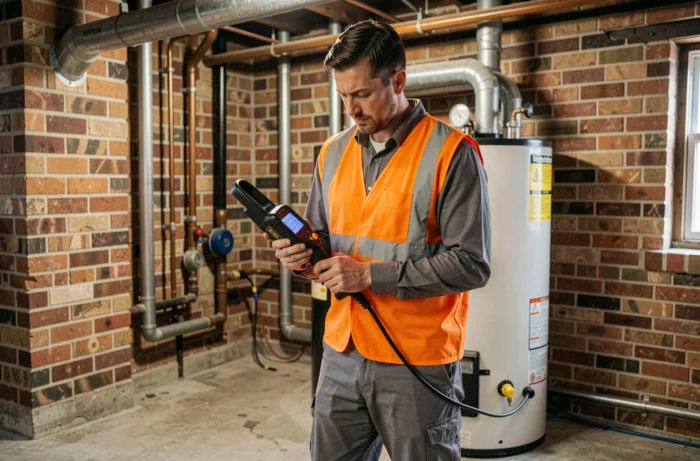
Ventilation of Attached Garage and Fuel Storage: Recent Regulatory Framework
The decree of July 27, 2026, amending the decree of January 31, 1986, has tightened the storage rules in residential parking boxes. Flammable liquids, including fuels, solvents, and paints, are now explicitly prohibited. This ban targets the overall calorific load of underground storage spaces.
In practical terms, keeping a can of gasoline in a residential box has become non-compliant. This rule, still little known, changes the habits of many residents who stored fuel for lawnmowers, generators, or recreational vehicles.
Mechanical Extraction in an Attached Garage
Field measurements show that simple mechanical extraction in an attached garage significantly reduces the contamination of the house with pollutants from fuels. This type of installation (an air extractor in the lower part of the garage) remains rare in older constructions, even though its effectiveness is documented.
For a garage communicating with the home, the airtightness of the connecting door and the low ventilation of the garage are the two parameters that determine whether vapors migrate to living spaces.
Eliminating Gasoline Smell from Contaminated Surfaces
Once the source has been addressed and the risk eliminated, cleaning the impregnated surfaces requires an approach suited to the material.
- On concrete: absorb as much liquid as possible with a granular material (mineral litter, diatomaceous earth), then clean with a degreaser suitable for hydrocarbons. Baking soda can complement the residual absorption phase.
- On textiles (clothing, carpets): wash separately, in cold water with white vinegar, without using the dryer as long as the smell persists. Heat sets hydrocarbons in the fibers.
- On untreated wood: superficial sanding if the impregnation is old. Wood absorbs VOCs deeply and releases them slowly.
Air renewal remains the most effective factor for lowering VOC concentration. No odor absorber can replace sustained ventilation for several hours after a spill.
A gasoline smell in a home is a chemical alert signal before being a nuisance. Addressing the source, ventilating the space, and checking fuel storage compliance cover the vast majority of situations, including those where the smell seems to appear for no reason.