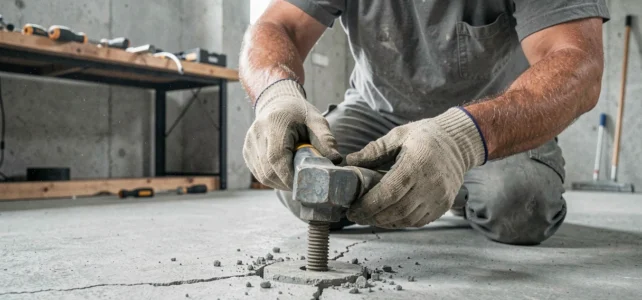
Removing a sealed anchor bolt from concrete requires a different approach depending on the fastening system in place. Identifying the exact type of anchor (mechanical expansion, removable concrete screw, chemical anchoring) determines the choice of tool, the risk of surface spalling, and the final result.
Diagnosis of the type of anchor: the factor that changes the entire method
The recent trend on construction sites is systematic diagnosis before any attempt at removal. A preliminary diagnosis allows for the selection of the right tool and helps avoid surface damage.
An expansion anchor (wedge anchor) works by deforming a metal cone that spreads wings against the wall of the hole. Once tightened, the expansion mechanism locks the anchor bolt in place almost permanently. Attempting to pull it straight up often tears off a piece of concrete from the surface.
In contrast, a concrete screw (such as Tapcon or equivalent) can be removed by simply unscrewing it when it has been properly installed. Some manufacturers now emphasize that a concrete screw can be extracted without residue or chiseling, provided it is unscrewed gradually and smoothly.
Before attempting to remove a concrete anchor bolt, one must observe the visible part of the fastening: presence of a nut on a threaded rod (expansion bolt), flush hexagonal or Torx head (concrete screw), or complete absence of protruding parts (female anchor type drop-in).
| Type of anchor | Fastening principle | Complete extraction possible | Risk to surface |
|---|---|---|---|
| Concrete screw (removable) | Direct threading into concrete | Yes, by unscrewing | Low if unscrewing gradually |
| Expansion bolt (wedge) | Cone + spread wings | Very difficult without breaking | High (frequent spalling) |
| Sleeve anchor | Expansion by nut tightening | Partial (preferred embedding) | Moderate |
| Drop-in anchor | Internal expansion by impact | Almost impossible cleanly | High if attempting to pull out |
| Chemical anchoring | Resin + threaded rod | No without peripheral drilling | Variable depending on the resin |
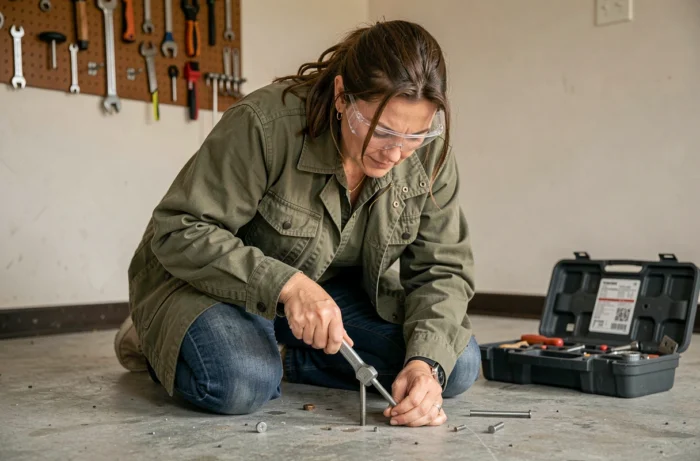
Extraction of an expansion bolt without breaking the concrete
The expansion bolt represents the most delicate case. Its locking mechanism is not designed to be reversed. Two approaches can limit surface damage.
Embedding below the surface
The most common method involves removing the nut and washer, then embedding the threaded rod below the level of the concrete using a punch and hammer. The expansion cone descends into the hole with the rod, relieving the surface stress.
The remaining hole is then filled with an appropriate repair mortar. This technique does not strictly remove the anchor but eliminates any protrusion and allows for a flat surface.
Gradual loosening with torque control
Recent field reports favor a more patient protocol: slightly tighten the nut, then loosen it a quarter turn, accompanied by slight lateral back-and-forth movements on the rod. This gradual cycle reduces the risk of spalling compared to a sudden pull.
If the rod eventually turns in the void, it means the cone has lost its grip. One can then attempt extraction with locking pliers by gently pulling upwards. However, if the rod remains stuck after several cycles, embedding remains the least destructive solution.
Removing a concrete screw: the simplest case as long as you don’t force it
A concrete screw is unscrewed. The principle is elementary, but putting it into practice requires diligence to avoid breaking the screw head or damaging the threading embedded in the concrete.
- Use a percussion drill set to a moderate torque, in unscrewing mode, rather than a hand wrench that may slip on the head.
- Apply a penetrating oil (like WD-40 or equivalent) if the screw has been in place for a long time, and let it act before forcing.
- Turn in quarter turns alternating clockwise and counterclockwise to break the resistance of the thread clogged with concrete dust.
- Ensure that the bit (Torx, hexagonal) exactly matches the imprint to avoid damaging the head.
A properly installed concrete screw is removed without residue and leaves a clean hole that is easy to fill. If the head breaks, the problem should be treated like a flush bolt (see below).
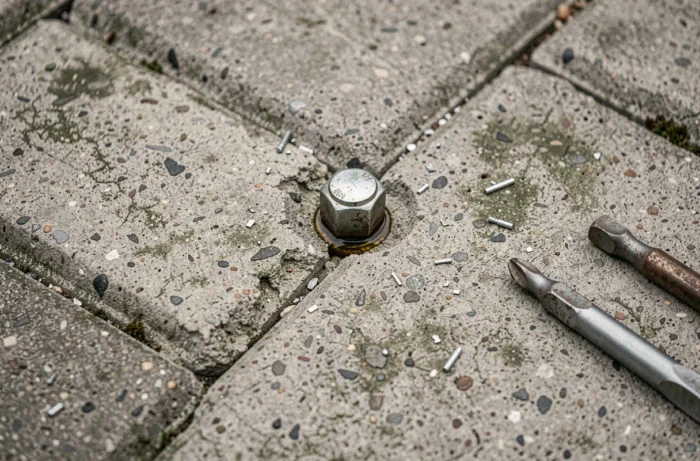
Bolt broken flush with the concrete: machining rather than direct impact
When a bolt breaks at the surface or a female anchor needs to be removed, the temptation to strike with a chisel is strong. Direct impact almost always causes concentric spalling around the anchor point, especially on old or decorative concrete.
The recommended approach on recent job sites involves finishing machining. A metal drill bit allows for drilling the center of the broken rod, then a screw extractor (left-hand drill) bites into the metal and frees the fragment by reverse rotation.
If the extractor is insufficient, localized coring with a small diameter diamond drill cuts a cylinder of concrete around the anchor. The hole is then filled with repair mortar. This technique preserves the surrounding surface much better than a chisel.
Filling the hole after extraction: mistakes that ruin the work
Removing the anchor is only half the job. A sloppy fill leaves a visible and fragile mark.
- Dust the hole with a compressor or a can of compressed air before applying the mortar. Concrete dust prevents the adhesion of the repair product.
- Lightly moisten the walls of the hole to prevent the dry concrete from absorbing the water from the mortar too quickly, which causes shrinkage and micro-cracking.
- Choose a shrinkage-compensated repair mortar rather than a simple quick-setting cement, which cracks as it dries in such a small volume.
A shrinkage-compensated mortar prevents cracking during shrinkage and provides a durable flush result. On an industrial floor or polished concrete, light finishing sanding after complete drying evens out the surface.
The choice of extraction method therefore entirely depends on the type of anchor identified at the outset. A concrete screw is unscrewed, an expansion bolt is embedded or worked through gradual cycles, and a broken bolt is machined. Forcing removal with a chisel or pry bar damages the surface and prolongs repair time.