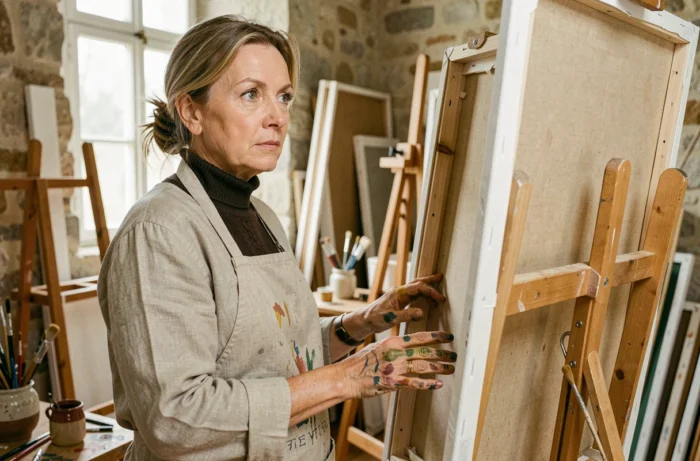
Béatrice Vonderweidt appears in search results through scattered fragments: a Pinterest profile, mentions in articles about her husband, a few traces of gallery exhibitions. Typing her name into a search engine leads to neither an official portfolio nor a structured gallery.
This observation raises a specific question: what documented elements allow us to trace her transition from modeling to painting, and what does the rarity of her photos reveal about her artistic approach?
Online Visual Presence of Béatrice Vonderweidt: An Atypical Profile for an Artist
Most contemporary painters use social media to showcase their works. Béatrice Vonderweidt does the opposite. Her digital footprint is limited to a Pinterest account under the name Beatrice Goldnadel Vonderweidt, featuring a few thematic boards (crafts, crochet, children’s inspirations), and a Facebook post from Magazine-economie mentioning her journey “from modeling to painting.”
No personal website, no public Instagram account dedicated to her pictorial production, no online gallery listing her paintings. This discretion contrasts with the usual functioning of the art market, where digital visibility often conditions access for collectors and curators.
By exploring the photos of Béatrice Vonderweidt and her painting, one can measure the distance between the scarcity of available images and the existence of a real artistic journey, documented by third parties.
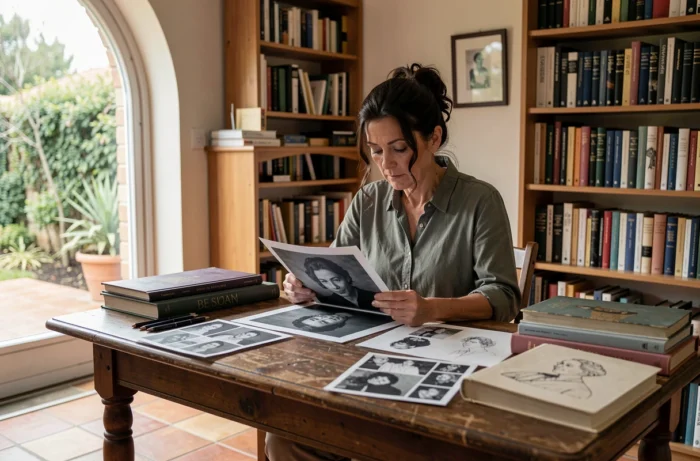
Identified Exhibitions: Timeline of Béatrice Vonderweidt’s Pictorial Journey
Online content often mentions a “transition to painting” without ever providing dates or locations. Accessible cultural sources allow us to reconstruct at least two concrete milestones.
| Year | Location | Event |
|---|---|---|
| 2008 | Institut français de Tel-Aviv | Group exhibition Regards croisés, presented as a painter |
| 2016 | Caprice Gallery, Tel-Aviv | Participation in a gallery exhibition |
These two milestones, separated by several years, confirm a sustainable practice. Béatrice Vonderweidt’s pictorial activity spans at least a decade, which invalidates the idea of a fleeting or anecdotal transition.
The choice of Tel-Aviv as an exhibition location is not trivial. The Institut français programs artists in an institutional setting, with a curatorial selection. The Caprice Gallery, on the other hand, is a commercial space that involves a dissemination approach to collectors.
Photos of Béatrice Vonderweidt: Why So Few Images Are Circulating
The scarcity of photos of Béatrice Vonderweidt online is not coincidental. It results from a deliberate choice to control her image, unusual for someone connected to the media world through her past as a model and her marriage to lawyer Gilles-William Goldnadel.
Several factors explain this situation:
- No identified public account on visual platforms dedicated to art (Instagram, Behance, ArtStation), preventing any indexing by search engines.
- Existing images are published by third parties (news articles, Facebook pages of economic media), never by Béatrice Vonderweidt herself.
- The right to one’s image in France protects individuals against the non-consensual dissemination of their photos, limiting the republication of images from her modeling days.
This voluntary absence creates a paradox. The search “Béatrice Vonderweidt photo” generates curiosity precisely because it leads to nothing structured. Discretion fuels the search instead of satisfying it.
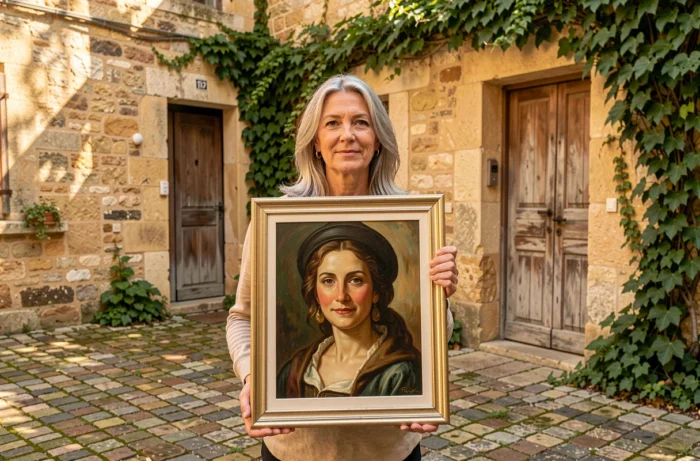
From Modeling to Painting: What the Change of Medium Reveals
Transitioning from model to painter means moving from a photographed object to a creative subject. This inversion of the relationship to the image deserves attention.
In modeling, the body serves as a medium for the creation of another (photographer, stylist, art director). The model embodies a vision that is not her own. In painting, the relationship reverses: the artist fully controls the visual production, from the choice of subject to the final composition.
The fact that Béatrice Vonderweidt was presented under the name Béatrice Goldnadel in the context of her exhibitions reinforces this interpretation. The change of her usage name marks a separation between two professional identities: the photographed muse on one side, the painter who signs her canvases on the other.
A Dissemination Strategy Outside Digital Circuits
The absence of an online gallery does not mean the absence of dissemination. Exhibitions in institutions (Institut français) and in commercial galleries (Caprice Gallery) attest to a journey that follows traditional art market circuits rather than digital platforms.
This positioning aligns with a generation of artists who prioritize physical contact with the artwork. The canvas is displayed on a wall, not on a screen, which also explains why search engines return almost no usable visual results.
Image Search and Right to One’s Image: The French Legal Framework
The temptation to republish old modeling photos encounters a strict legal framework. In France, the right to one’s image is based on Article 9 of the Civil Code, which protects the respect for private life. Any dissemination of a photograph depicting an identifiable person requires their consent, even if the image was taken in a professional context.
For photos from modeling, distribution rights are generally limited in time and confined to a specific use (advertising campaign, fashion editorial). Republishing them on a third-party site, years later, without updated permission, constitutes a potential infringement of the right to one’s image.
The risk is amplified by Béatrice Vonderweidt’s low online presence. With few official images available, any unauthorized photo takes on disproportionate visibility in search results.
Béatrice Vonderweidt’s journey from modeling to painting remains documented by institutional traces rather than by a voluntary digital presence. The two identified exhibitions in Tel-Aviv, in 2008 and 2016, constitute the only verifiable milestones of an artistic activity that the scarcity of images online makes difficult to visually assess, but which spans a duration incompatible with a mere announcement effect.