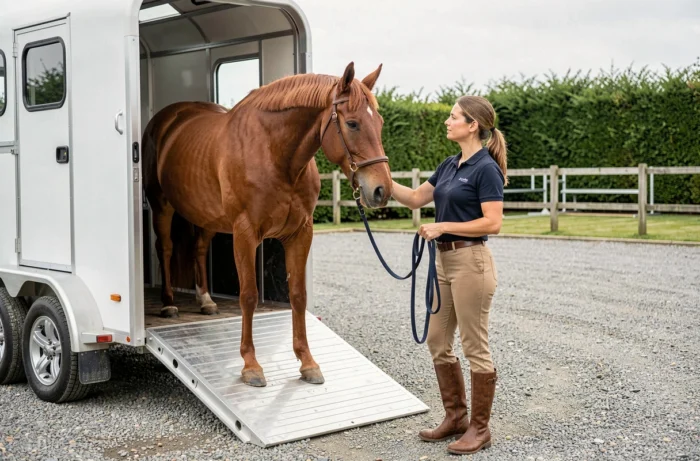
A horse that travels poorly remembers it for a long time. A forced ascent, a sudden stop, or a slippery surface can turn every future loading into a test of strength. However, transporting horses is part of everyday equestrian life, whether for a competition, a stable change, or a veterinary consultation. Preparing the journey methodically radically changes the experience for both the animal and the handler.
Signs of stress in transported horses: what to watch for
Before even discussing equipment or regulations, one point deserves full attention: the horse’s stress is visible in its body. Excessive sweating at the neck, repeated whinnying, nervous pawing, or attempts to turn around in the trailer are all signals of discomfort.
These reactions are not trivial. A stressed horse loses its balance more easily, risks injuring itself against the walls, and arrives at its destination exhausted. Transport also exacerbates respiratory problems: the prolonged head-up position promotes mucus accumulation in the airways.
Specialized transporters like those listed on equitorne.fr incorporate these parameters into the design of their services, adapting the duration of breaks and the vehicle’s ventilation conditions.
Have you ever noticed that a horse refuses to get into a trailer even though it accepted it the last time? It is often the memory of an uncomfortable journey that resurfaces. Every failed transport complicates the next one, which is why it is important to pay attention to every detail from the very first experience.
Transport protections for horses: boots, tail guards, and beyond
The choice of protections directly influences the safety of the journey. Transport boots cover the cannon, the fetlock, and extend down to the coronet of the hoof. They absorb shocks if the horse loses its balance or steps on itself during a turn.
- Full transport boots protect from the knee to the hoof and are suitable for long journeys where the risk of rubbing increases with fatigue.
- The tail guard prevents injuries from rubbing against the rear bar of the trailer, common in horses that lean while traveling.
- The bell boots, placed around the coronet, protect the heel of the pastern, a vulnerable area when the horse is pawing in a confined space.
- A lightweight blanket or a suitable quarter sheet regulates body temperature without causing overheating in a closed vehicle.
A common mistake is to overprotect a horse that has never worn boots. Acclimate the horse to the protections several days before transport. An equine that discovers boots in the trailer will add stress to an already new situation.
Trailer setup and comfort during the journey
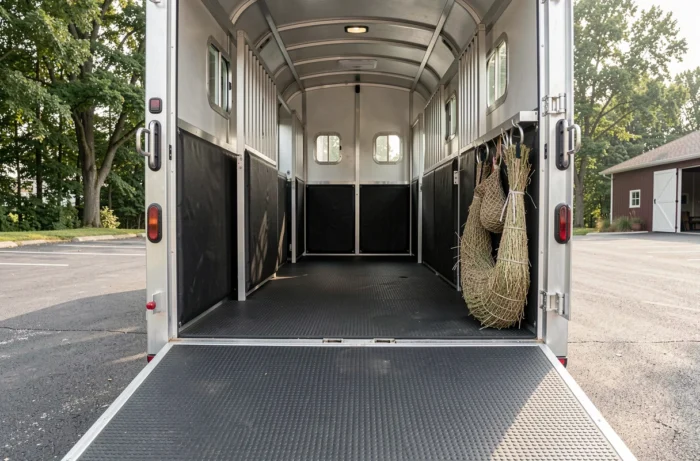
The vehicle itself plays a crucial role. A well-maintained non-slip floor reduces the risk of slipping, a frequent cause of limb injuries. The bedding (shavings or straw) absorbs vibrations and facilitates urine drainage.
Ventilation and temperature in the vehicle
A closed trailer heats up quickly, especially when stationary. The ventilation must allow for constant air renewal without creating a direct draft on the horse. In summer, prefer departures early in the morning or late in the day to avoid heat peaks.
Access to water remains an underestimated issue. On a journey lasting several hours, offering water during breaks reduces the risk of dehydration and colic. A dehydrated horse recovers less well and remains more vulnerable to stress in the hours following arrival.
Driving adapted to equine transport
The driver makes a difference just as much as the equipment. Gradual accelerations, anticipated braking, and wide turns reduce imbalances in the trailer. A horse that manages to stay stable on all four feet expends less energy and arrives calmer.
Regular breaks (every three to four hours for long journeys) allow the horse to lower its head, which clears the airways. This simple action limits transport pleurisy, a lung condition related to prolonged standing with the head held high.
Regulations for horse transport: obligations to know
The European regulation (EC) No. 1/2005 of December 22, 2004, governs the transport of live animals, including horses. This text imposes specific conditions on the duration of the journey, the animal’s fitness for travel, and the transporter’s qualifications.
For individuals, a category B license is sufficient if the loaded car plus trailer with horse does not exceed the regulatory limit. Beyond that, a B96 or BE license becomes necessary. Check the total authorized weight before each departure, as overloading exposes you to a fine and, more importantly, to dangerous driving behavior.
Public pressure is evolving on this subject. A YouGov survey commissioned by World Horse Welfare in February 2026 reveals that the majority of respondents in five European countries (France, Germany, Spain, Italy, Poland) consider that transport poses a risk to the welfare of equines. More than half of respondents support a maximum limit of nine hours for journeys to the slaughterhouse, while European law still allows up to twenty-four consecutive hours.
These results indicate a likely tightening of rules in the coming years. Professional transporters who anticipate these standards already offer better service, with planned breaks, veterinary follow-up, and vehicles designed for the animal’s comfort.
Transporting a horse is not just about getting it into a trailer. The respiratory health, emotional state, and physical safety of the animal depend on a chain of decisions made well before departure. Appropriate protections, well-ventilated vehicles, smooth driving, and respect for break times form a coherent whole. A horse that travels well arrives ready to perform, adapt to its new environment, or simply regain its calm.